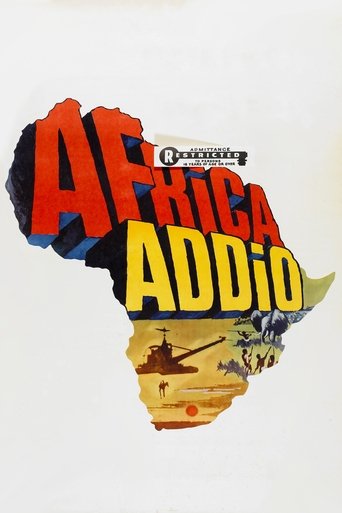
Africa Addio (1966)
A chronicle of the violence that occurred in much of the African continent throughout the 1960s. As many African countries were transitioning from colonial rule to other forms of government, violent political upheavals were frequent. Revolutions in Zanzibar and Kenya in which thousands were killed are shown, the violence not only political; there is also extensive footage of hunters and poachers slaughtering different types of wild animals.
- Data de estreia
- 1966-02-11
- TMDB
- 6.3 / 10 (56)
- Duração
- 2 h 18 min
- Géneros
- Documentário, Guerra
- Realizador
- Gualtiero Jacopetti, Franco Prosperi
- Coleção
- Mondo Cane Collection
Elenco
- Sergio Rossi — Narrator (voice)
- Jomo Kenyatta — (archive footage)
- Gualtiero Jacopetti — Himself (uncredited)
- Julius Nyerere — Himself (uncredited)
- Moïse Kapenda Tshombe — Himself (uncredited)
- Richard Gordon Turnbull — Himself (uncredited)
- Ian Yule — Himself (uncredited)
Curiosidades
Africa Addio is a 1966 Italian mondo documentary film co-directed, co-edited and co-written by Gualtiero Jacopetti and Franco E. Prosperi with music by Riz Ortolani. Jacopetti and Prosperi had gained fame as the directors of Mondo Cane in 1962.
Production
The film was shot over the course of three years across most of sub-Saharan Africa. Most notably, the film features footage from the DR Congo, Tanganyika, Zanzibar, Uganda, Rwanda, Portuguese Angola, Kenya and South Africa. The documentary also includes some behind-the-scenes footage from the 1964 film Zulu. Production was done on 35mm, a rarity for documentaries, which were almost always shot on 16mm at the time.
The filmmakers were in near-constant danger for most of filming, with Tanganyika and Zanzibar being especially dangerous. In Zanzibar, their planes were shot at and they witnessed rebels lighting a plane crewed by Germans on fire and capturing the people inside. In Dar es Salaam, they were almost shot for photographing a massacre. Jacopetti suffered a cut after a soldier smashed their vehicle's windshield with the butt of his rifle.
A soundtrack of the music used in the film was later released. The composer was Riz Ortolani (who had scored Mondo Cane that featured the tune later used for the hit single More). When making Africa Addio, lyrics were added to Ortolani's title theme, making a song called "Who Can Say?" that was sung by Jimmy Roselli.
Prior to the film's release, allegations arose that a scene depicting the execution of a Congolese Simba rebel was actually a murder done for the cameras. This resulted in co-director Gualtiero Jacopetti being arrested on charges of snuff filming. The film's footage was seized by police, and the editing process was halted during the legal proceedings. He was acquitted after he and co-director Franco E.
A tie-in book with the same title, written by John Cohen, was released by Ballantine to coincide with the film's release.
Ler na Wikipédia · Texto da Wikipédia, CC BY-SA 4.0. Dados do Wikidata.
Recomendados
- Para Sama 2019 · ★ 8.2
- O Labirinto de Kubrick 2012 · ★ 6.1
- A Noite Cairá 2014 · ★ 7.6
- We Live in Public 2009 · ★ 6.8
- The Kid Stays in the Picture 2002 · ★ 6.6
- H.H. Holmes: America's First Serial Killer 2004 · ★ 6.2
- Z Channel: A Magnificent Obsession 2004 · ★ 7.1
- I Called Him Morgan 2016 · ★ 7.0
- The Decline of Western Civilization Part II: The Metal Years 1988 · ★ 6.8
- One Child Nation 2019 · ★ 7.2
- Stop at Nothing: The Lance Armstrong Story 2014 · ★ 7.3
- QT8: The First Eight 2019 · ★ 7.2