On Tour (2010)
Tournée
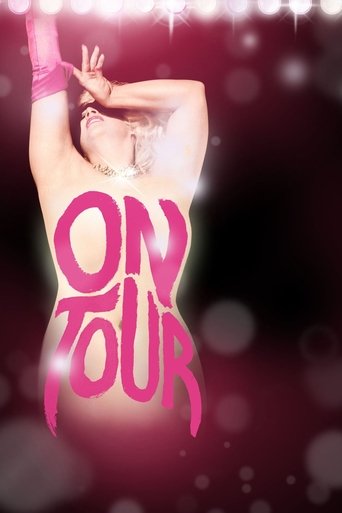
After leaving France in search of a better life in America, a television producer returns with a group of burlesque dancers to take the Paris club scene by storm.
- Date of release
- 2010-06-30
- TMDB
- 6.3 / 10 (75)
- Runtime
- 1h 51m
- Genres
- Comedy, Drama
- Director
- Mathieu Amalric
Casting
- Miranda Colclasure — Mimi Le Meaux
- Suzanne Ramsey — Kitten on the Keys
- Dirty Martini — Dirty Martini
- Julie Atlas Muz — Julie Atlas Muz
- Angela de Lorenzo — Evie Lovelle
- Alexander Craven — Roky Roulette
- Mathieu Amalric — Joachim Zand
- Damien Odoul — François
- Ulysse Klotz — Ulysse
- Simon Roth — Baptiste
- Joseph Roth — Balthazar
- Aurélia Petit — Fille de la station service
Interesting facts
- Filmed in: Nantes
On Tour is a 2010 internationally co-produced comedy-drama film directed by Mathieu Amalric. It stars Amalric himself as a producer who brings an American Neo-Burlesque troupe to France, played by genuine performers Mimi Le Meaux, Kitten on the Keys, Dirty Martini, Julie Atlas Muz, Evie Lovelle and Roky Roulette. In a road movie narrative, the plot follows the troupe as they tour French port cities with their show, which was performed for actual audiences during the production. The inspiration for the film was a book by Colette about her experience from music halls in the early 20th century, and a part of Amalric's aim was to translate the sentiment of the book to a modern setting.
Production
The idea for the film came from the 1913 book The Other Side of Music-Hall by Colette, a collection of texts written for a newspaper about her life during a music hall tour in the French provinces. The project started around the same time as the suicide of independent film producer Humbert Balsan, which also had made an impression on Amalric. "I'm fascinated by producers.
The film was produced by Les Films du Poisson for a budget of 3.52 million Euro, including co-production support from Arte France, German company Neue Mediopolis and an advance on receipts from the National Center of Cinematography and the moving image. The director originally envisioned Portuguese producer Paulo Branco in the role of Joachim, but decided to cast himself only weeks before filming started.
Filming started in April 2009 and lasted two months. The troupe went on an actual tour along French port cities in order to provide the necessary footage. Hundreds of local extras performed as themselves as audiences. Locations were used in Le Havre, La Rochelle, Nantes and Rochefort. For the visual style Amalric drew inspiration from American cinema of the 1970s, and in particular The Killing of a Chinese Bookie by John Cassavetes.
Read on Wikipedia · Text from Wikipedia, CC BY-SA 4.0. Data from Wikidata.
Recommended
- SubUrbia 1997 · ★ 6.2
- No Love Lost 2023 · ★ 6.1
- New Biz in the Hood 2019 · ★ 5.8
- Meet the Leroys 2024 · ★ 6.2
- Whatever It Takes 2026 · ★ 6.1
- The Girl from Paris 2001 · ★ 6.5
- Bye Bye Morons 2020 · ★ 7.2
- Alice and the Mayor 2019 · ★ 6.2
- See The Sea 2025 · ★ 6.1
- My Own Love Song 2010 · ★ 6.2
- Two Tickets to Greece 2023 · ★ 5.9
- Hooking Up 2020 · ★ 6.3