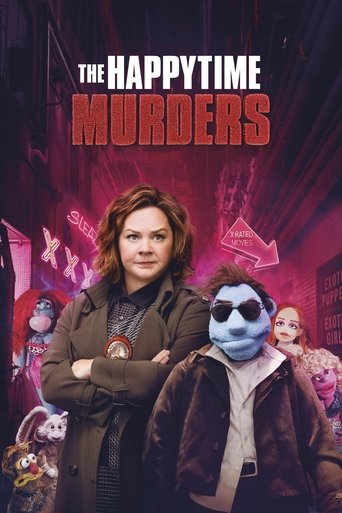
The Happytime Murders (2018)
No sesame. All street.
In a world where humans coexist with puppets—who are seen as lesser citizens—cast members of a beloved 1990s children's television series begin getting murdered one by one. Puppet Phil Philips, an ex-LAPD detective-turned-private eye, takes on the case at the request of his old boss in order to assist his former partner, Detective Connie Edwards.
- Date of release
- 2018-08-22
- TMDB
- 5.8 / 10 (1124)
- Runtime
- 1h 31m
- Genres
- Action, Crime, Comedy
- Director
- Brian Henson
Casting
- Melissa McCarthy — Detective Connie Edwards
- Bill Barretta — Phil Philips / Junkyard / Boar (voice)
- Leslie David Baker — Lt. Banning
- Elizabeth Banks — Jenny
- Joel McHale — Agent Campbell
- Maya Rudolph — Bubbles
- Dorien Davies — Sandra (voice)
- Drew Massey — Goofer / Vinny (voice)
- Kevin Clash — Bumblypants / Lyle (voice)
- Michael McDonald — Ronovan Scargle
- Cynthy Wu — Brittenie Marlowe
- Mitch Silpa — Tommy
Interesting facts
The Happytime Murders is a 2018 American black comedy film directed by Brian Henson and written by Todd Berger from a story by Berger and Dee Austin Robertson. The film stars Melissa McCarthy, Bill Barretta, Joel McHale, Maya Rudolph, Leslie David Baker, and Elizabeth Banks. Set in a world where humans and living puppets co-exist, the film follows a puppet private investigator and a human police detective who must solve a murder spree of retired sitcom stars.
Production
Announced in 2008 as being in development at The Jim Henson Company, serving as the company's first film to receive an R rating from the Motion Picture Association of America, the film was picked up two years later by Lionsgate with a targeted January 2011 start date. At the time, Cameron Diaz had been offered a lead role in the film. Diaz dropped out and Katherine Heigl entered into talks to replace her.
In July 2015, it was announced that STX Entertainment had picked up the film rights to The Happytime Murders (Lionsgate having lost them) and put the film in active development, with script revisions by Erich and Jon Hoeber. In April 2016, Jamie Foxx entered negotiations to star in the film.
Principal photography on the film began in Los Angeles, California, on September 11, 2017. The film had a production budget in the range of $40–47 million, with McCarthy paid between $10 and 17.5 million.
There were a total of 125 puppets in the film with 40 created specifically for it. To accommodate the puppeteers, all of the sets were built up so that the puppeteers could stand on the floor, since their optimum way to operate the puppets is if they are standing with straight arms. Because the floor of the sets came up in pieces, the human actors had a two-foot (61 cm) margin to stay on their path.
Read on Wikipedia · Text from Wikipedia, CC BY-SA 4.0. Data from Wikidata.
Recommended
- The Hard Way 1991 · ★ 6.2
- Deep Cover 2025 · ★ 6.7
- Mystery Team 2009 · ★ 6.1
- CHiPs 2017 · ★ 6.1
- 2 Guns 2013 · ★ 6.5
- Flashback 1990 · ★ 6.3
- Tango & Cash 1989 · ★ 6.5
- Keanu 2016 · ★ 6.0
- Midnight Run 1988 · ★ 7.2
- Trap House 2025 · ★ 6.6
- Bad Boys: Ride or Die 2024 · ★ 7.3
- Hot Fuzz 2007 · ★ 7.6