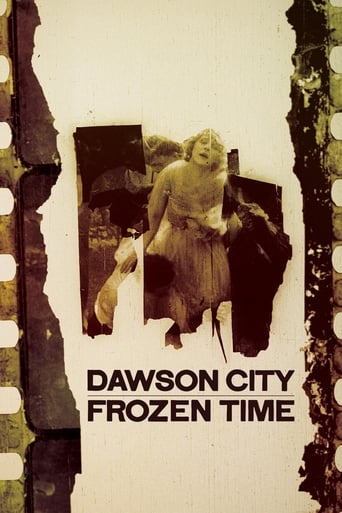
Dawson City: Frozen Time (2017)
Film Was Born Of An Explosive.
The true history of a collection of some 500 films dating from 1910s to 1920s, which were lost for over 50 years until being discovered buried in a sub-arctic swimming pool deep in the Yukon Territory, in Dawson City, located about 350 miles south of the Arctic Circle.
- Date of release
- 2017-06-09
- TMDB
- 6.8 / 10 (73)
- Runtime
- 2h 0m
- Genres
- Documentary
- Director
- Bill Morrison
Casting
- Kathy Jones-Gates — Herself
- Michael Gates — Himself
- Sam Kula — Himself
- Bill O'Farrell — Himself
- Chris 'Mad Dog' Russo — Himself
- Bill Morrison — Himself
Interesting facts
- Box office: $111.6K
Dawson City: Frozen Time is a 2016 American documentary film written, edited, and directed by Bill Morrison, and produced by Morrison and Madeleine Molyneaux. First screened in the Orizzonti competition section at the 73rd Venice International Film Festival, the film details the history of the remote Yukon town of Dawson City, from the Klondike Gold Rush to the 1978 Dawson Film Find: a discovery of 533 nitrate reels containing numerous lost films. The recovered silent films, buried beneath a hockey rink in 1929, included shorts, features, and newsreel footage of various events, such as the 1919 World Series.
Production
Bill Morrison had initially intended for this project to result in something similar to his 12-minute short The Film of Her (1996), but he came to envision a broader scope as his work on it progressed. Morrison was able to recruit Alex Somers as composer after learning that the band Sigur Ros, with whom Somers collaborates, were fans of his previous film Decasia (2002).
Michael Gates and Kathy Jones-Gates, employees of Parks Canada and the Dawson Museum, respectively, were two of the early authorities on the Dawson City Film Find. Morrison filmed an interview with them both in 2014, though he did not originally plan to include the footage in the final film.
Read on Wikipedia · Text from Wikipedia, CC BY-SA 4.0. Data from Wikidata.
Recommended
- The Walking Dead: The Return 2024 · ★ 7.5
- Naqoyqatsi 2002 · ★ 6.2
- Stories We Tell 2012 · ★ 7.1
- The Class of ‘92 2013 · ★ 7.1
- Nothing Like a Dame 2018 · ★ 6.8
- Seduced and Abandoned 2013 · ★ 6.2
- Powaqqatsi 1988 · ★ 7.2
- Earth 2007 · ★ 7.7
- Behind the Planet of the Apes 1998 · ★ 7.1
- Everything or Nothing 2012 · ★ 7.3
- Iron Maiden: Burning Ambition 2026 · ★ 8.5
- Love, Marilyn 2013 · ★ 6.5