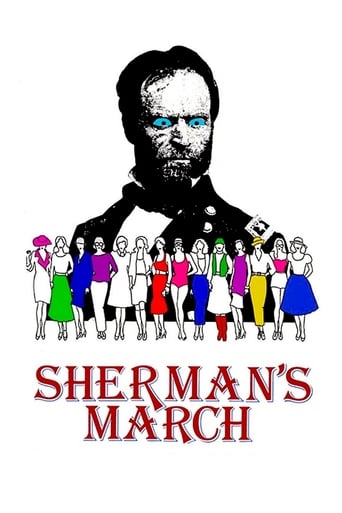
La marcha de Sherman (1986)
Sherman's March
Ross McElwee se propone hacer un documental sobre los efectos persistentes de la marcha de destrucción del General Sherman por el Sur durante la Guerra Civil, pero se ve continuamente desviado por las mujeres que van y vienen en su vida, sus sueños recurrentes de holocausto nuclear, y Burt Reynolds .
- Fecha de estreno
- 1986-09-05
- TMDB
- 6.3 / 10 (46)
- Duración
- 2 h 38 min
- Géneros
- Documental
- Director
- Ross McElwee
Reparto
- Ross McElwee — Self
- Dede McElwee — Self
- Patricia Rendleman — Self
- Charleen Swansea — Self
- Ross McElwee Jr. — Self
- Burt Reynolds — Self
- Tom McElwee — Self
- Wini Wood — Self
- Dee Dee Geraty — Self
- Joyous Perrin — Self
- Richard Leacock — Self - Historical Narration (voice)
Curiosidades
- Rodada en: Carolina del Sur
- Premios: 1 · Nominaciones: 0. Incluyendo: Sundance Film Festival Grand Jury Prize for Best Documentary
Sherman's March: A Meditation on the Possibility of Romantic Love In the South During an Era of Nuclear Weapons Proliferation is a 1986 cinéma vérité documentary film written and directed by Ross McElwee. It was awarded a Grand Jury prize at the 1987 Sundance Film Festival, and was selected for preservation in the U.S. National Film Registry in 2000.
Production
McElwee called his previous film Backyard "a sketch for Sherman's March, an experiment in how I could approach the bigger film". He called the former film "cruder" because I was just learning to shoot as a one-person crew. I was just getting over that odd sense of camera shyness in reverse. It takes a while to summon the gumption to shoot people you know well, to be able to face them and talk to them as you're filming.
Initially, McElwee thought the film would be a "synthesis of Backyard and Space Coast," but the day after filming the Scottish games, his sister said—somewhat seriously, somewhat joking—"You should use the camera as a way to meet women." She's sincerely upset about my having ended my relationship with my girlfriend, and she's looking for ways to get me back on my feet. ...
McElwee set out to film Sherman's March with just a $9,000 grant (equivalent to $26,942 in 2025), and began conducting mostly impromptu interviews. "Pretty much I always walked in on them," he said, characterizing his methods. "I guess what my conversations have that conventional interviews don't is a serendipitous quality, and emotional charge that has something to do with the personal connection between the subject and the film-maker.
Principal photography lasted about five months, and McElwee estimated that he shot about 25 hours of footage: I was almost always ready to shoot. I kept the camera within reaching distance, sometimes balanced on my shoulder ... Even between major portraits, when I was on the road, I was totally open to filming whatever might happen in a gas station or in a restaurant, or wherever. So in one sense you can count all that time as "filming time."
Leer en Wikipedia · Texto de Wikipedia, CC BY-SA 4.0. Datos de Wikidata.
Recomendadas
- Naqoyqatsi 2002 · ★ 6.2
- I Am Heath Ledger 2017 · ★ 7.4
- Public Speaking 2011 · ★ 7.0
- Come See Me in the Good Light 2025 · ★ 7.0
- Drew: The Man Behind the Poster 2013 · ★ 7.0
- En el camino, de cuando en cuando, vislumbré breves momentos de belleza 2000 · ★ 7.8
- The Curse of the Dragon 1993 · ★ 7.2
- Cuando caiga la noche 2014 · ★ 7.6
- La Casa de Papel: el fenómeno 2020 · ★ 7.4
- Halloween: 25 Years of Terror 2006 · ★ 6.8
- The Class of ‘92 2013 · ★ 7.1
- Gilbert 2017 · ★ 6.7