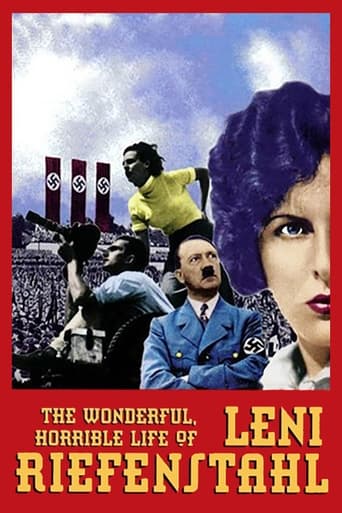
The Wonderful Horrible Life of Leni Riefenstahl (1993)
Die Macht der Bilder: Leni Riefenstahl
This documentary recounts the life and work of one of most famous, and yet reviled, German film directors in history, Leni Riefenstahl. The film recounts the rise of her career from a dancer, to a movie actor to the most important film director in Nazi Germany who directed such famous propaganda films as Triumph of the Will and Olympiad. The film also explores her later activities after Nazi Germany's defeat in 1945 and her disgrace for being so associated with it which includes her amazingly active life over the age of 90.
- Date of release
- 1993-09-11
- TMDB
- 7.2 / 10 (34)
- Runtime
- 3h 8m
- Genres
- Documentary
- Director
- Ray Müller
Casting
- Leni Riefenstahl — Herself
- Walter Frentz — Himself
- Horst Kettner — Himself
- Ray Müller — Himself
- Luis Trenker — Himself
- Guzzi Lantschner — Himself
Interesting facts
The Wonderful, Horrible Life of Leni Riefenstahl is a 1993 German documentary film about the life of German film director Leni Riefenstahl, directed by Ray Müller.
Production
Riefenstahl was best known for her documentary film Olympia (1938), on the 1936 Summer Olympics in Berlin and her Nazi propaganda films, Der Sieg des Glaubens (1933), Triumph of the Will (1935), and Tag der Freiheit (1935), which are regarded by historians as among the greatest propaganda films of all time.
The United States release of this film, in 1993, coincided with the publication of Riefenstahl's autobiography Leni Riefenstahl: A Memoir (New York, 1993), as well as with her ninetieth birthday. The two releases are not unrelated. The Wonderful, Horrible Life of Leni Riefenstahl was born from an idea of Riefenstahl herself, who, motivated by her old age and already working on her memoirs, decided to commission a documentary about her life.
Concerned about being associated with the 'Nazi director', eighteen filmmakers declined the project, before Müller agreed to portray Riefenstahl in what ended up being a three-hour-long documentary (three times its contract length).
The length of the film is therefore the result of a decision by the director: Müller justifies it as an attempt to give a fair representation of Riefenstahl's life, which cannot be reduced to the eight years she worked for the Nazi regime, but presents much more interesting stories and facts that are relevant to understand her personality.
Read on Wikipedia · Text from Wikipedia, CC BY-SA 4.0. Data from Wikidata.
Recommended
- Riefenstahl 2024 · ★ 7.1
- Hitler: A Career 1977 · ★ 7.4
- Fuck 2006 · ★ 6.4
- Triumph of the Will 1935 · ★ 6.9
- Anselm 2023 · ★ 6.6
- Eldorado: Everything the Nazis Hate 2023 · ★ 7.1
- Come See Me in the Good Light 2025 · ★ 6.9
- Night Will Fall 2014 · ★ 7.6
- Love, Gilda 2018 · ★ 7.2
- Frank and Ollie 1995 · ★ 7.4
- QT8: The First Eight 2019 · ★ 7.2
- I Am Heath Ledger 2017 · ★ 7.3