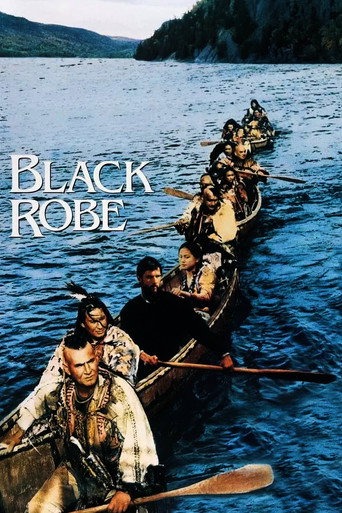
Black Robe (1991)
In the winter of 1634, an extraordinary man began a perilous journey into the North American wilderness.
Missionary Father LaForgue travels to the New World in hopes of converting Algonquin Indians to Catholicism. Accepted, though warily, by the Indians, LaForgue travels with the Indians using his strict Catholic rules and ideals to try and impose his religion.
- Date of release
- 1991-10-04
- TMDB
- 6.5 / 10 (133)
- Runtime
- 1h 41m
- Genres
- Adventure, Drama, History
- Director
- Bruce Beresford
Casting
- Lothaire Bluteau — Laforgue
- Sandrine Holt — Annuka
- August Schellenberg — Chomina
- Tantoo Cardinal — Chomina's Wife
- Lawrence Bayne — Neehatin
- Aden Young — Daniel
- Billy Two Rivers — Ougebmat
- Wesley Côté — Oujita
- Frank Wilson — Father Jerome
- François Tassé — Father Bourque
- Jean Brousseau — Champlain
- Yvan Labelle — Mestigoit
Interesting facts
- Box office: A$2M
- Based on: Black Robe
- Awards: 2 · Nominations: 10. Including: Academy of Canadian Cinema and Television Award for Best Motion Picture; AACTA Award for Best Cinematography
Black Robe is a 1991 historical drama film directed by Bruce Beresford, adapted by Brian Moore from his 1985 novel of the same name. Set in the 17th century, it depicts the adventures of a Jesuit missionary tasked with founding a mission in New France. To do so, he must traverse 2,400 km of harsh wilderness with the help of a group of Algonquins, facing danger from both the unfamiliar environment and rival tribes. The title refers to the nickname given to the Jesuits by the Algonquins, referring to his black cassock.
Production
Bruce Beresford wanted to make a film based on Brian Moore's novel since it was first published. The rights had been acquired by Canada's Alliance Films, which had signed another director. That person fell out, as did another director, before the job was given to Beresford. Beresford stated:
I think that, even if you have no religious faith whatever or, even if you despised the Jesuits, you would still find it an interesting story. It's a wonderful study of obsession and love. And it is a wonderful adventure of the spirit and of the body. What those people did, going to a country where winters were far more severe than anything they had known in Europe, meeting people who were far more fierce than anyone they had ever encountered...
The film remained in development hell for over four years due to no major American studio willing to finance the project. Beresford was only able to convince Alliance Films to hire him after his previous film, Driving Miss Daisy, won the Academy Award for Best Picture. The success of Dances with Wolves, a film with similar themes released the prior year, also convinced Alliance of the project's viability.
Funds were raised under a co-production treaty between Canada and Australia. The production needed 30% Australian financing, and the Film Finance Corporation investment had to be spent on Australian elements, such as an Australian crew and two Australian actors.
The film was shot primarily on-location in Quebec, in the Saguenay–Lac-Saint-Jean region. Additional scenes were shot in Rouen in northern France. The entire film was shot in-sequence.
Read on Wikipedia · Text from Wikipedia, CC BY-SA 4.0. Data from Wikidata.
Recommended
- The Mission 1986 · ★ 7.4
- Squanto: A Warrior's Tale 1994 · ★ 6.8
- The Lost City of Z 2017 · ★ 6.4
- Unconquered 1947 · ★ 6.5
- The Left Hand of God 1955 · ★ 6.3
- Cave Rescue 2019 · ★ 6.0
- Mutiny on the Bounty 1935 · ★ 7.4
- The Way West 1967 · ★ 6.1
- Endless Night 2015 · ★ 6.1
- Robin Hood: Prince of Thieves 1991 · ★ 6.9
- Lost on a Mountain in Maine 2024 · ★ 7.1
- Wake of the Red Witch 1948 · ★ 5.9