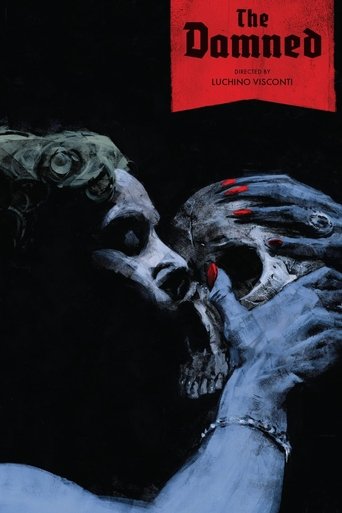
The Damned (1969)
La caduta degli dei
He was soon to become the second most powerful man in Nazi Germany.
In the early days of Nazi Germany, a powerful noble family must adjust to life under the new dictatorship regime.
- Date of release
- 1969-10-30
- TMDB
- 7.3 / 10 (242)
- Runtime
- 2h 38m
- Genres
- Drama, History
- Director
- Luchino Visconti
Casting
- Dirk Bogarde — Frederick Bruckmann
- Ingrid Thulin — Sophie Von Essenbeck
- Helmut Griem — Aschenbach
- Helmut Berger — Martin Von Essenbeck
- Renaud Verley — Günther Von Essenbeck
- Umberto Orsini — Herbert Thallman
- Reinhard Kolldehoff — Konstantin von Essenbeck
- Albrecht Schoenhals — Baron Joachim Von Essenbeck
- Florinda Bolkan — Olga
- Nora Ricci — Governess
- Charlotte Rampling — Elisabeth Thallman
- Irina Wanka — Lisa Keller
Interesting facts
- Filmed in: Germany, Austria, Lake Como, and Lierna
- Awards: 0 · Nominations: 1
The Damned (Götterdämmerung) is a 1969 historical drama film directed by Luchino Visconti, from a screenplay he co-wrote with Nicola Badalucco and Enrico Medioli. It stars Dirk Bogarde, Ingrid Thulin, Helmut Berger, Helmut Griem, Umberto Orsini, Charlotte Rampling, Florinda Bolkan, Reinhard Kolldehoff and Albrecht Schönhals in his final film.
Production
The film was shot on location in West Germany and Austria, and at Cinecittà Studios in Rome. Locations included Düsseldorf, Essen, and Unterach am Attersee - the latter doubling for Bad Wiessee. The scenes of the Essenbeck steelworks were shot in Terni, Italy.
The Damned was the breakthrough film for Helmut Berger, who is given an "Introducing" credit, even though he had already appeared in Visconti's segment of the anthology film The Witches. At the time, Berger was in a romantic relationship with Visconti. Dirk Bogarde later expressed disappointment with Visconti for sacrificing his character's development to place a greater focus on Berger's Martin.
Composer Maurice Jarre was hired by the producers without the knowledge of Visconti, who originally wanted the film scored entirely with pre-existing classical music by Mahler and Wagner. Visconti reportedly was dissatisfied with the composer's efforts, which he compared disparagingly to Jarre's work on Doctor Zhivago, but was forced to use the music due to contractual obligations.
In Visconti's preferred, primarily English-language version of the film, most of the cast members provide their own voices, but Umberto Orsini is dubbed by an uncredited actor, due to his accent.
Nazi war criminal Karl Hass appeared in the film as an extra. Hass was a perpetrator of the Ardeatine massacre, but was not charged or convicted until 1998, allegedly due to his work as an American agent against the Soviet Union in the 1950s. It's unknown if the filmmakers were aware of Hass' identity when he appeared in the film, though some sources suggest he was employed as a technical advisor.
Read on Wikipedia · Text from Wikipedia, CC BY-SA 4.0. Data from Wikidata.
Recommended
- Conspiracy 2001 · ★ 7.3
- The Cook, the Thief, His Wife & Her Lover 1989 · ★ 7.3
- The Grey Zone 2001 · ★ 6.6
- Apt Pupil 1998 · ★ 6.5
- The Good Shepherd 2006 · ★ 6.4
- Once Upon a Time in America 1984 · ★ 8.4
- The Funeral 1996 · ★ 6.8
- Truth & Treason 2025 · ★ 8.1
- Dark Places 2015 · ★ 5.9
- The Boys from Brazil 1978 · ★ 6.7
- Operation Finale 2018 · ★ 6.7
- Georgetown 2019 · ★ 5.9