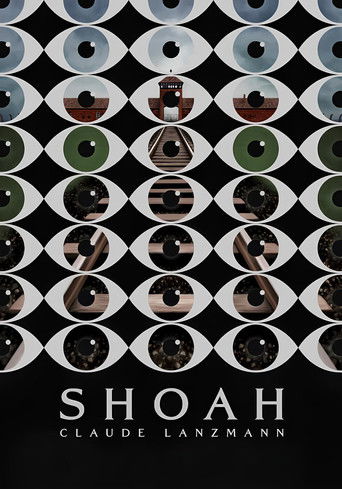
Shoah - Extermínio (1985)
Shoah
Director Claude Lanzmann spent 11 years on this sprawling documentary about the Holocaust, conducting his own interviews and refusing to use a single frame of archival footage. Dividing Holocaust witnesses into three categories – survivors, bystanders, and perpetrators – Lanzmann presents testimonies from survivors of the Chelmno concentration camp, an Auschwitz escapee, and witnesses of the Warsaw Ghetto Uprising, as well as a chilling report of gas chambers from an SS officer at Treblinka.
- Data de estreia
- 1985-04-21
- TMDB
- 8.2 / 10 (230)
- Duração
- 9 h 26 min
- Géneros
- Documentário, História
- Realizador
- Claude Lanzmann
Elenco
- Claude Lanzmann — Self - Interviewer
- Simon Srebnik — Self
- Michael Podchlebnik — Self
- Motke Zaidl — Self
- Jan Karski — Self
- Paula Biren — Self
- Abraham Bomba — Self
- Inge Deutschkron — Self
- Ruth Elias — Self
- Richard Glazar — Self
- Filip Müller — Self
- Rudolf Vrba — Self
Curiosidades
Shoah is a 1985 French documentary film about the Holocaust, directed by Claude Lanzmann. Over nine hours long and eleven years in the making, the film presents Lanzmann's interviews with survivors, witnesses and perpetrators during visits to German Holocaust sites across Poland, including extermination camps.
Production
Lanzmann was initially commissioned by Israeli officials to make what they thought would be a two-hour film, delivered in 18 months, about the Holocaust from "the viewpoint of the Jews". As time went on, Israeli officials withdrew as his original backers, but Lanzmann persevered, eventually taking eleven years to complete Shoah. The film was plagued by financial problems, difficulties tracking down interviewees, and threats to Lanzmann's life.
Many German interviewees were reluctant to talk or refused to be filmed, so Lanzmann used a hidden camera, producing a grainy, black-and-white appearance. The interviewees in these scenes are sometimes obscured or distinguished by technicians watching the recording. During one interview, with Heinz Schubert, the covert recording was discovered by Schubert's family, and Lanzmann was physically attacked.
Lanzmann arranged many of the scenes, but not the testimony, before filming witnesses. For example, Bomba was interviewed while cutting his friend's hair in a working barbershop; a steam locomotive was hired to recreate the journey the death train conductor had taken while transporting Jews; and the opening scene shows Srebnik singing in a rowboat, similarly to how he had "serenaded his captors".
The first six years of production were devoted to the recording of interviews in 14 countries. Lanzmann worked on the interviews for four years before first visiting Poland. After the shooting, editing of the 350 hours of raw footage continued for five years. Lanzmann frequently replaced the camera shot of the interviewee with modern footage from the site of the relevant death camp.
The outtakes from Shoah were purchased by the United States Holocaust Memorial Museum in Washington D.C. on October 11, 1996. Museum staff have been engaged in conserving and digitizing 185 hours of interview outtakes and 35 hours of location filming. Transcripts of the interviews, in original languages and English translations, are held by the United States Holocaust Memorial Museum.
Ler na Wikipédia · Texto da Wikipédia, CC BY-SA 4.0. Dados do Wikidata.
Recomendados
- The Untold History Of The United States 2012 · ★ 8.2
- Human 2015 · ★ 8.4
- Woody Allen: Um Documentário 2011 · ★ 6.9
- No Direction Home: Bob Dylan 2005 · ★ 7.8
- Musk 2026 · ★ 6.7
- Never Sleep Again: The Elm Street Legacy 2010 · ★ 7.8