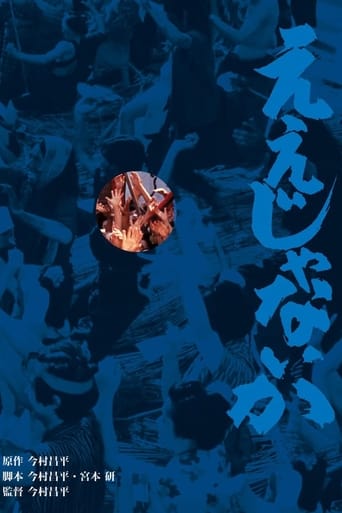
ええじゃないか (1981)
The film depicts carnivalesque atmosphere summed up by the cry "Ei ja nai ka" ("Why not?") in Japan in 1867 and 1868 in the days leading to the Meiji Restoration. It examines the effects of the political and social upheaval of the time, and culminates in a revelrous march on the Tokyo Imperial Palace, which turns into a massacre. Characteristically, Imamura focuses not on the leaders of the country, but on characters in the lower classes and on the fringes of society.
- Erscheinungsdatum
- 1981-01-08
- TMDB
- 6.2 / 10 (18)
- Laufzeit
- 2 Std. 31 Min.
- Genres
- Drama
- Regie
- Shōhei Imamura
Besetzung
- Kaori Momoi — Ine
- 泉谷しげる — Genji
- 草刈正雄 — Itoman
- 緒形拳 — Furukawa
- 伴淳三郎 — Toramatsu
- 三木のり平 — Masuya
- 田中裕子 — Omatsu
- 池波志乃 — Yoshino
- Shigeru Tsuyuguchi — Kinzo
- 小沢昭一 — Sakunojo
- Yasuaki Kurata — Hanjiro
- 火野正平 — Magoshichi
Wissenswertes
Der Dieb und die Geisha ist ein japanischer Film von Shōhei Imamura aus dem Jahr 1981.
Auf Wikipedia weiterlesen · Text aus Wikipedia, CC BY-SA 4.0. Daten aus Wikidata.
Empfohlen
- Tenchu! 1969 · ★ 7.0
- Okami - Das Schwert der Rache 1972 · ★ 7.4
- Killing 2018 · ★ 7.1
- Daibosatsu toge - The Sword of Doom 1966 · ★ 7.8
- Rurouni Kenshin 2: Kyoto Inferno 2014 · ★ 7.6
- Samurai Rebellion 1967 · ★ 8.2
- Okami - Blutiger Schnee 1974 · ★ 7.1
- 13 Assassins 2010 · ★ 7.3
- Lady Snowblood 1973 · ★ 7.5
- Harakiri 1962 · ★ 8.5
- Yojimbo - Der Leibwächter 1961 · ★ 8.1
- Samurai 1965 · ★ 7.3