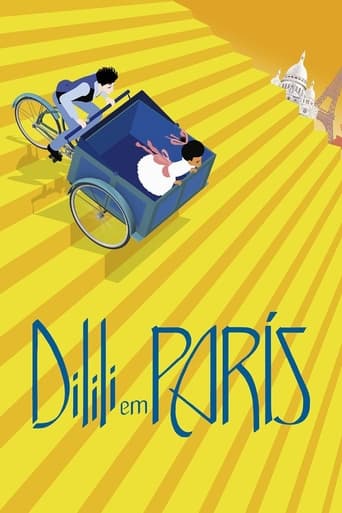
Dilili à Paris (2018)
Com a ajuda do seu amigo entregador, Dilili, uma jovem Kanak, investiga uma série de sequestros misteriosos de jovens raparigas que assolam a Paris da Belle Époque. No decorrer da sua investigação, ela encontra uma série de personagens extraordinários, cada um dos quais lhe fornece pistas que a ajudarão na sua busca… Após Kirikou e Azur & Asmar, Michel Ocelot volta com uma nova história encantadora de jovens heróis corajosos, mistérios e descobertas, sequestros e provações, lugares extraordinários e encontros mágicos, em que o bem deve desafiar forças sombrias e triunfar.
- Data de estreia
- 2018-10-10
- TMDB
- 6.6 / 10 (157)
- Duração
- 1 h 33 min
- Géneros
- Animação, Aventura
- Realizador
- Michel Ocelot
Elenco
- Elisabeth Duda — Marie Curie / Gertrude Stein / Countess Greffülhe / Madeleine Lemaire (voice)
- Liliane Rovère — Louise Michel (voice)
- Prunelle Charles-Ambron — Dilili (voice)
- Thissa d'Avila Bensalah — Colette / Camille Claudel / Suzanne Valadon / Berthe Morisot (voice)
- Enzo Ratsito — Orel (voice)
- Natalie Dessay — Emma Calvé (voice)
- Isabelle Guiard — Sarah Bernhardt / Ana de Noailles / 'La Goulue' / Supervising mistress / Mother of a family (voice)
- Swan Mirabeau — Eve Curie / Irène Curie (voice)
- Léa Powe — Kanak villager (voice)
- Karim M'Ribah — Debussy (voice)
- Olivier Voisin — Erik Satie (voice)
- Bruno Paviot — Lebeuf / Pasteur / Lumière brothers / Sewage worker (voice)
Curiosidades
Dilili in Paris is a 2018 animated period adventure film written and directed by Michel Ocelot, with pre-production by Studio O and animation production by Mac Guff, about a Kanak girl investigating a mystery in Paris in the Belle Époque. It stars the voices of Prunelle Charles-Ambron, Enzo Ratsito, and Natalie Dessay as Emma Calvé in the original, French-language version.
Production
Director, writer, and designer Michel Ocelot has said that two starting points for the production were his desire to create a work set in Paris, and an originally separate desire to create one on the topic of male suppression and abuse of women and girls.
He chose to combine these in a narrative which takes place in the Belle Époque, roughly in the 1900s, a decade in which several historical firsts for women in France were made.
The film depicts some of the many notable historical figures who were often present in the city at the time, and features a fictionalized version of the opera singer Emma Calvé as a supporting character. However, it simultaneously intentionally diverges from real history (and, as the director readily admits, laws of science) in its metaphorical main plot and inclusion of retrofuturist technology influenced by various works of Jules Verne and The…
The 3D rendering style continues in that used in Azur & Asmar, in that the fabric, hair, and so on of the three-dimensional models is rendered as solid colours with no shading, though it differs in that the characters' bodies (which in Azur & Asmar were shaded from a fixed angle, in a style inspired by late medieval art) are defined with a tracing effect developed from that used in Kirikou and the Men and Women.
The scenery incorporates photographs, taken by Ocelot over four years, of structures which survive from the depicted era or earlier, including the Palais Garnier, Bouillon Racine, Maxim's and the Paris sewers and objects from the collections of the Musée d'Orsay, Musée de l'École de Nancy, Musée Carnavalet, Musée Rodin, Musée du quai Branly – Jacques Chirac, and Musée Marmottan Monet, which are used directly as two-dimensional elements or for tex…
Ler na Wikipédia · Texto da Wikipédia, CC BY-SA 4.0. Dados do Wikidata.
Recomendados
- Um Monstro em Paris 2011 · ★ 6.9
- As Aventuras de Tintin: O Segredo do Licorne 2011 · ★ 6.9
- Miraculous World: Paris, As Aventuras de Shadybug e Garra Noir 2024 · ★ 7.3
- Bailarina 2016 · ★ 7.2
- Miraculous World: As Aventuras de Ladybug em Londres, A corrida contra o tempo 2024 · ★ 7.6
- Os Mestres do Tempo 1982 · ★ 7.2
- Cães do Ártico - Uma Aventura no Gelo 2019 · ★ 5.9
- The Summit of the Gods 2021 · ★ 7.7
- Os Flofos - Viagem no Tempo 2021 · ★ 6.2
- Caçadores de Trolls: A Ascensão dos Titãs 2021 · ★ 7.5
- Mr. Link 2019 · ★ 6.9
- Miraculous: As Aventuras de Ladybug - O Filme 2023 · ★ 7.6