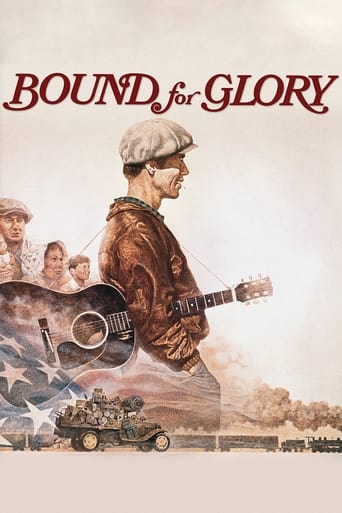
Bound for Glory (1976)
A biography of Woody Guthrie, one of America's greatest folk singers. He left his dust-devastated Texas home in the 1930s to find work, discovering the suffering and strength of America's working class.
Casting
- David Carradine — Woody Guthrie
- Ronny Cox — Ozark Bule
- Melinda Dillon — Mary / Memphis Sue
- Gail Strickland — Pauline
- John Lehne — Locke
- Ji-Tu Cumbuka — Slim Snedeger
- Randy Quaid — Luther Johnson
- Elizabeth Macey — Liz
- Susan Vaill — Gwen Guthrie
- Sarah Vaill — Gwen Guthrie
- Alexandra Mock — Sue Guthrie
- Kimberly Mock — Sue Guthrie
Interesting facts
- Based on: Bound for Glory
- Awards: 2 · Nominations: 6. Including: Academy Award for Best Cinematography; Academy Award for Best Original Song Score
Bound for Glory is a 1976 American biographical film directed by Hal Ashby, produced by folk music impresario and Woody Guthrie's manager Harold Leventhal and loosely adapted by Robert Getchell from Guthrie's 1943 partly fictionalized autobiography Bound for Glory. The film stars David Carradine as folk singer Woody Guthrie, with Ronny Cox, Melinda Dillon, Gail Strickland, John Lehne, Ji-Tu Cumbuka and Randy Quaid. Much of the film is based on Guthrie's attempt to humanize the desperate Okie Dust Bowl refugees in California during the Great Depression.
Production
Arthur Krim of United Artists agreed to finance the film on the basis of Hal Ashby's reputation, even before a star had signed on.
Dustin Hoffman and Jack Nicholson both turned down the role of Woody Guthrie. Richard Dreyfuss was considered. Tim Buckley was going to be offered the part but died of a drug overdose. Ashby interviewed David Carradine but turned him down, in part because he felt Carradine was too tall. However, over time he reconsidered. "He had the right rural look and the musicianship," said Ashby.
The railroad scenes were filmed on the Sierra Railroad. Ashby wanted a "big" freight train for the movie, as opposed to the shorter trains commonly used in filmmaking. The railroad assembled a train of 34 freight cars. Scenes taking place on the Texas panhandle that did not include views of a locomotive were filmed near Stockton, California, using diesel locomotives.
Read on Wikipedia · Text from Wikipedia, CC BY-SA 4.0. Data from Wikidata.
Recommended
- I Saw the Light 2016 · ★ 6.2
- Back to Black 2024 · ★ 6.7
- Cradle Will Rock 1999 · ★ 6.5
- Springsteen: Deliver Me from Nowhere 2025 · ★ 6.6
- Honkytonk Man 1982 · ★ 6.4
- Inside Llewyn Davis 2013 · ★ 7.2
- Respect 2021 · ★ 6.8
- Chaplin 1992 · ★ 7.4
- Elvis 2022 · ★ 7.4
- Beyond the Sea 2004 · ★ 6.3
- Whitney Houston: I Wanna Dance with Somebody 2022 · ★ 7.0
- The Way Back 2010 · ★ 7.0