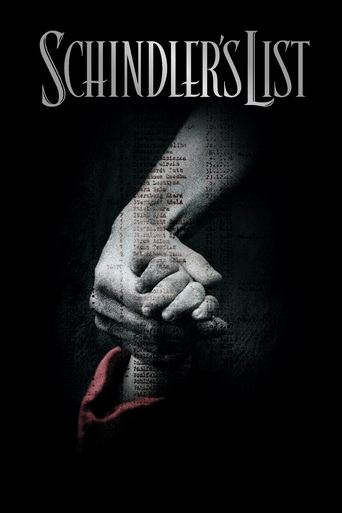
Schindler's List (1993)
Whoever saves one life, saves the world entire.
The true story of how businessman Oskar Schindler saved over a thousand Jewish lives from the Nazis while they worked as slaves in his factory during World War II.
- Date of release
- 1993-12-15
- TMDB
- 8.6 / 10 (18241)
- Runtime
- 3h 15m
- Genres
- Drama, History, War
- Director
- Steven Spielberg
Casting
- Liam Neeson — Oskar Schindler
- Ben Kingsley — Itzhak Stern
- Ralph Fiennes — Amon Goeth
- Caroline Goodall — Emilie Schindler
- Jonathan Sagall — Poldek Pfefferberg
- Embeth Davidtz — Helen Hirsch
- Małgorzata Gebel — Viktoria Klonowska
- Shmuel Levy — Wilek Chilowicz
- Mark Ivanir — Marcel Goldberg
- Béatrice Macola — Ingrid
- Andrzej Seweryn — Julian Scherner
- Friedrich von Thun — Rolf Czurda
Interesting facts
- Box office: $322.1M
- Budget: $25M
- Earned 12.9× its budget
- Based on: Schindler's Ark
- Filmed in: Kraków
- Awards: 12 · Nominations: 12. Including: Academy Award for Best Picture; Amanda Award for Best Foreign Feature Film; Academy Award for Best Director; Academy Award for Best Cinematography
Schindler's List is a 1993 American historical drama film directed and co-produced by Steven Spielberg and written by Steven Zaillian. It is based on the historical novel Schindler's Ark (1982) by Thomas Keneally. The film follows Oskar Schindler, a German industrialist who saved more than a thousand mostly Polish–Jewish refugees from the Holocaust by employing them in his factories during World War II. It stars Liam Neeson as Schindler, Ralph Fiennes as SS officer Amon Göth, and Ben Kingsley as Schindler's Jewish accountant Itzhak Stern.
Production
Poldek Pfefferberg, one of the Schindlerjuden, made it his life's mission to tell the story of his savior. Pfefferberg attempted to produce a biographical film of Oskar Schindler with Metro-Goldwyn-Mayer (MGM) in 1963, with Howard Koch writing, but the deal fell through. In 1982, Thomas Keneally published his historical novel Schindler's Ark, which he wrote after a chance meeting with Pfefferberg in Los Angeles in 1980.
Spielberg was unsure if he was mature enough to make a film about the Holocaust, and the project remained "on [his] guilty conscience." Spielberg tried to pass the project to director Roman Polanski, but he refused Spielberg's offer. Polanski's mother was killed at Auschwitz, and he had lived in and survived the Kraków Ghetto. Polanski eventually directed his own Holocaust drama The Pianist (2002).
It took me years before I was really ready to make Schindler’s List. I had a lot of projects on my shelves that were of a political nature and had "social deed" written all over them—even had "politically correct" stamped on top of them. And I didn’t make those films, because I was censoring that part of me by saying to myself, "That’s not what the public will accept from you.
Spielberg finally decided to take on the project when he noticed that Holocaust deniers were being given serious consideration by the media. With the rise of neo-Nazism after the fall of the Berlin Wall, he worried that people were too accepting of intolerance, as they were in the 1930s. Sid Sheinberg greenlit the film on condition that Spielberg made Jurassic Park first.
In 1983, Keneally was hired to adapt his book, and he turned in a 220-page script. His adaptation focused on Schindler's numerous relationships, and Keneally admitted he did not compress the story enough. Spielberg hired Kurt Luedtke, who had adapted the screenplay of Out of Africa, to write the next draft. Luedtke gave up almost four years later, as he found Schindler's change of heart too unbelievable.
Read on Wikipedia · Text from Wikipedia, CC BY-SA 4.0. Data from Wikidata.
Recommended
- The Courageous Heart of Irena Sendler 2009 · ★ 7.4
- The World Will Tremble 2025 · ★ 7.5
- The Grey Zone 2001 · ★ 6.6
- Adam Resurrected 2008 · ★ 6.1
- The Zookeeper's Wife 2017 · ★ 7.3
- Conspiracy 2001 · ★ 7.3
- Resistance 2020 · ★ 7.0
- The Pianist 2002 · ★ 8.4
- Nuremberg 2025 · ★ 7.6
- Irena's Vow 2024 · ★ 7.7
- Escape from Sobibor 1987 · ★ 7.2
- Emancipation 2022 · ★ 7.7