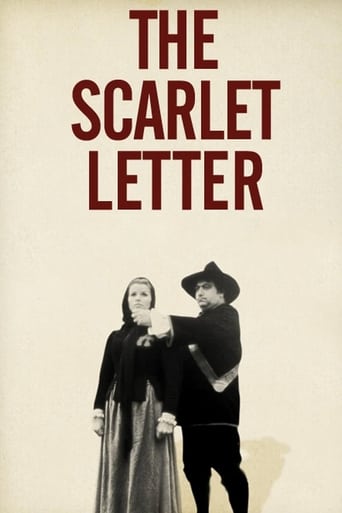
The Scarlet Letter (1973)
Der scharlachrote Buchstabe
In 17th-century Salem, Hester Prynne must wear a scarlet A because she is an adulteress, with a child out of wedlock. For seven years, she has refused to name the father. A vigorous older stranger arrives, recognized by Hester but unknown to others as her missing husband. He poses as Chillingworth, a doctor, watching Hester and searching out the identity of her lover. His eye soon rests on Dimmesdale, a young overwrought pastor. Enmity grows between the two men; Chillingworth applies psychological pressure, and the pastor begins to crack. A ship stops in Salem, and Hester sees it as a providential refuge for her daughter, herself, and her lover. But will Dimmesdale flee with her?
- Date of release
- 1973-03-13
- TMDB
- 5.4 / 10 (26)
- Runtime
- 1h 30m
- Genres
- History, Drama, TV Movie
- Director
- Wim Wenders
Casting
- Senta Berger — Hester Prynne
- Hans Christian Blech — Roger Chillingworth
- Lou Castel — Rev. Dimmesdale
- Rüdiger Vogler — The Sailor
- Yelena Samarina — Mistress Hibbins, the daughter of Gov. Bellingham
- Yella Rottländer — Pearl
- William Layton — Gov. Bellingham
- Alfredo Mayo — Gov. Fuller
- Ángel Álvarez — Rev. Wilson
- Laura Currie — Sarah
- Tito García — Church Attendant
- Lorenzo Robledo — Captain
Interesting facts
- Based on: The Scarlet Letter
- Filmed in: Madrid and Cologne
The Scarlet Letter is a 1973 period drama film directed by Wim Wenders, based on Nathaniel Hawthorne's 1850 novel of the same name. The West German-Spanish co-production stars Senta Berger as Hester Prynne, Lou Castel as Reverend Dimmesdale, and Hans Christian Blech as Chillingworth.
Production
Filming took place at a studio in Cologne, with exteriors shot in Galicia, Spain. The look of the evening shots outdoors utilized the existing day for night techniques of exposure.
According to the director's commentary, Wim Wenders explained that the experience of directing this, his second film, was the usual one which occurs with a new director. It is much more difficult and much less successful. In the interior shots, the windows were covered with a variant of washi paper seen in traditional Japanese homes.
Wenders has said that he was unhappy that the movie was filmed on locations in Spain instead of Massachusetts, noting his relative youth made him not prepared to make a 16th-century period movie.
There are a few brief shots in which one sees a three-masted ship on the ocean in the background. This was not a real ship but was a small model sized correctly for the shot and hung in front of the lens (called forced perspective). Only one extra building had to be erected in Galicia for the exterior shooting to hide the large gap between buildings.
As far as the actors were concerned, they were from all over Europe and so all of the dialogue had to be looped afterward. Six or seven different languages were being spoken by the actors. The extras which represent the inhabitants of Salem were all Spaniards.
Read on Wikipedia · Text from Wikipedia, CC BY-SA 4.0. Data from Wikidata.
Recommended
- The Immortal Life of Henrietta Lacks 2017 · ★ 6.3
- TalhotBlond 2012 · ★ 6.3
- Cheaters 2000 · ★ 6.3
- How Sarah Got Her Wings 2015 · ★ 5.9
- Mary 2024 · ★ 6.3
- Meltdown: Days of Destruction 2006 · ★ 6.0
- Rose 2026 · ★ 7.7
- Inherit the Wind 1999 · ★ 6.3
- Grey Gardens 2009 · ★ 6.8
- All the Way 2016 · ★ 6.7
- Hello Sister, Goodbye Life 2006 · ★ 6.1
- The Scarlet and the Black 1983 · ★ 7.1