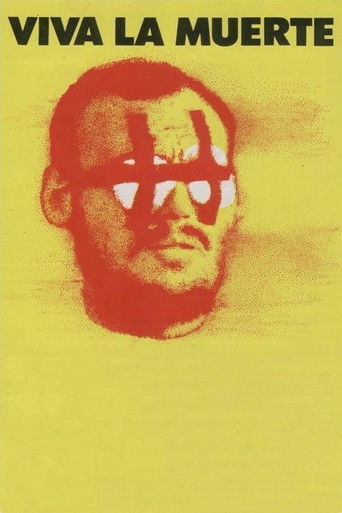
Viva la muerte (1971)
At the end of the Spanish civil war, Fando, a boy of about ten, tries to make sense of war and his father's arrest. His mother is religious, sympathetic to the Fascists; his father is accused of being a Red. Fando discovers that his mother may have aided in his father's arrest. Sometimes we witness Fando imagining explanations for what's going on; sometimes we see him at play, alone or with his friend Thérèse. Oedipal fantasies and a lad's natural curiosity about sex and death mix with his search for his mother's nature and his father's fate. Will Fando survive the search?
- Data lansării
- 1971-05-12
- TMDB
- 5.8 / 10 (45)
- Durată
- 1 h 30 min
- Genuri
- Dramă, Război
- Regizor
- Fernando Arrabal
Distribuție
- Mohamed Bellasoued — Colonel
- Anouk Ferjac — The aunt
- Núria Espert — The mother
- Mahdi Chaouch — The son
- Ivan Henriques — Tosan, the father
- Jazia Klibi — Thérèse, Fando's friend
- Suzanne Comte — The grandmother
- Víctor García — Fando, 20 years old
Curiozități
Viva la Muerte is a 1971 internationally produced drama film shot in Algeria, France, Spain, Italy, Portugal, Brazil, Philippines, Morocco and Tunisia and directed by Fernando Arrabal. The film was released on 12 May 1971 and Arrabal drew on his own childhood for inspiration for the movie. Viva la Muerte takes place at the end of the Spanish Civil War, telling the story of Fando, a young boy whose father was turned in to authorities as a suspected communist by his Falange-sympathizing mother. It has gained cult popularity as a midnight movie. The opening credits sequence features drawings by artist, actor and novelist Roland Topor.
Citește pe Wikipedia · Text din Wikipedia, CC BY-SA 4.0. Date din Wikidata.
Recomandate
- Eden and After 1970 · ★ 6.2
- Evadarea din Sobibor 1987 · ★ 7.2
- Victimele războiului 1989 · ★ 7.2
- I Stand Alone 1999 · ★ 7.4
- Născut pe 4 iulie 1989 · ★ 7.0
- Polar: Viforul morții 2019 · ★ 6.4
- Land of the Blind 2006 · ★ 5.8
- Dead Man's Shoes 2004 · ★ 7.1
- Dublura diavolului 2011 · ★ 6.7
- Țapi ispășitori 2011 · ★ 5.9
- Polițistul 1988 · ★ 6.4
- Himera 1978 · ★ 6.7