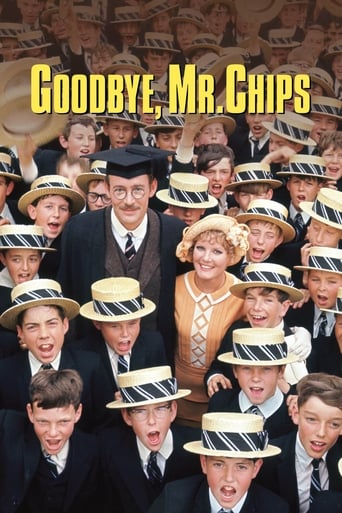
Goodbye, Mr. Chips (1969)
He is a shy schoolmaster. She is a music hall star. They marry and immediately have 283 children...all boys!
Academy Award-honoree Peter O'Toole stars in this musical classic about a prim English schoolmaster who learns to show his compassion through the help of an outgoing showgirl. O'Toole, who received his fourth Oscar-nomination for this performance, is joined by '60s pop star Petula Clark and fellow Oscar-nominee Michael Redgrave.
- Date of release
- 1969-11-05
- TMDB
- 6.8 / 10 (54)
- Runtime
- 2h 35m
- Genres
- Drama, Music, Romance
- Director
- Herbert Ross
Casting
- Peter O'Toole — Arthur Chipping
- Petula Clark — Katherine Bridges
- Michael Redgrave — The Headmaster
- George Baker — Lord Sutterwick
- Siân Phillips — Ursula Mossbank
- Michael Bryant — Max Staefel
- Jack Hedley — William Baxter
- Alison Leggatt — Headmaster's Wife
- Jenny Runacre
- Clinton Greyn — Bill Calbury
- Barbara Couper — Mrs. Paunceforth
- Michael Culver — Johnny Longbridge
Interesting facts
- Based on: Goodbye, Mr. Chips
- Awards: 1 · Nominations: 2. Including: National Board of Review: Top Ten Films
Goodbye, Mr. Chips is a 1969 British-American musical film directed by Herbert Ross. The screenplay by Terence Rattigan is based on James Hilton's 1934 novella Goodbye, Mr. Chips, which was first adapted for the screen in 1939.
Production
A draft of a musical adaptation of Goodbye, Mr. Chips was on file in the Metro-Goldwyn-Mayer script department as early as 1951. In 1964, trade magazine advertisements announced that Julie Andrews, fresh from her success in Mary Poppins, was to star in a Mr. Chips musical opposite Rex Harrison, with Vincente Minnelli as director, but nothing came of the project.
The film's songs were written by Leslie Bricusse, who replaced André and Dory Previn. Nora Kaye, wife of Herbert Ross, choreographed Clark's two musical production numbers. Ken Adam served as the film's art director, and Julie Harris designed the costumes.
Much of the film was made on location. In Italy, scenes were shot in Campania, Capaccio, Naples, Paestum, Pompeii, and Positano. In London, 59 Strand-on-the-Green in Chiswick served as Katherine's home, and the Salisbury, a popular bar in the West End theatre district, was the setting for a scene in which Chips and Katherine share a drink after watching a performance of Medea.
Terence Rattigan's screenplay diverged significantly from Hilton's novella and the 1939 film adaptation. Firstly, the time frame of the story was advanced by several decades, starting in the 1920s, continuing through the Second World War, and ending in the late 1960s. Also, the musical does not show Chipping's first arrival at Brookfield School but starts with him already an established member of the teaching staff.
Terry Kilburn, who had portrayed the four generations of the Colley family in the original 1939 film, was approached to appear in a different role in the 1969 remake. However, due to a scheduling conflict, Kilburn was unable to appear in the film.
Read on Wikipedia · Text from Wikipedia, CC BY-SA 4.0. Data from Wikidata.
Recommended
- Endless Love 2014 · ★ 6.9
- The Best of Me 2014 · ★ 7.5
- Shout 1991 · ★ 5.8
- Flipped 2010 · ★ 8.0
- The Whole Wide World 1996 · ★ 6.6
- A Walk to Remember 2002 · ★ 7.7
- Women in Love 1969 · ★ 6.6
- Persuasion 2007 · ★ 7.2
- Pure Country 2: The Gift 2010 · ★ 6.7
- Music of the Heart 1999 · ★ 6.7
- The Secret Scripture 2017 · ★ 7.2
- The Secret: Dare to Dream 2020 · ★ 7.4