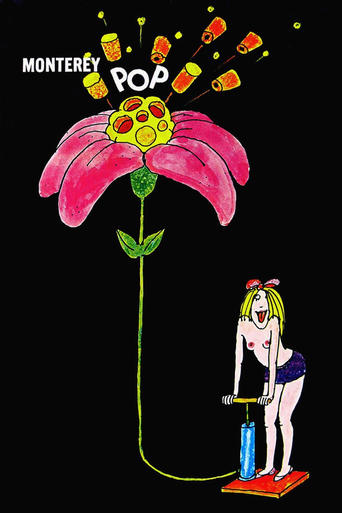
Monterey Pop (1968)
Do you know where your kids are hanging out tonight?
Featuring performances by popular artists of the 1960s, this concert film highlights the music of the 1967 California festival. Although not all musicians who performed at the Monterey Pop Festival are on film, some of the notable acts include the Mamas and the Papas, Simon & Garfunkel, Jefferson Airplane, the Who, Otis Redding, and the Jimi Hendrix Experience. Hendrix's post-performance antics -- lighting a guitar on fire, breaking it and tossing a part into the audience -- are captured.
- Date of release
- 1968-12-26
- TMDB
- 7.4 / 10 (102)
- Runtime
- 1h 20m
- Genres
- Music, Documentary
- Director
- D. A. Pennebaker
Casting
- Scott McKenzie — Self
- Denny Doherty — Self - Mamas and the Papas
- Cass Elliot — Self - Mamas and the Papas
- John Phillips — Self - Mamas and the Papas
- Michelle Phillips — Self - Mamas and the Papas
- Frank Cook — Self - Canned Heat
- Bob Hite — Self - Canned Heat
- Larry Taylor — Self - Canned Heat
- Henry Vestine — Self - Canned Heat
- Paul Simon — Self - Simon and Garfunkel
- Art Garfunkel — Self - Simon and Garfunkel
- Hugh Masekela — Self
Interesting facts
Monterey Pop is a 1968 American concert film by D. A. Pennebaker that documents the Monterey International Pop Festival of 1967. Among Pennebaker's several camera operators were fellow documentarians Richard Leacock and Albert Maysles. The painter Brice Marden has an "assistant camera" credit. Titles for the film were by the illustrator Tomi Ungerer. Featured performers include Big Brother and the Holding Company with Janis Joplin, Jefferson Airplane, Hugh Masekela, Otis Redding, Ravi Shankar, the Mamas & the Papas, the Who, and the Jimi Hendrix Experience, whose namesake set his guitar on fire, broke it on the stage, then threw the neck of his guitar in the crowd at the end of "Wild Thing".
Production
The American Broadcasting Company put up a $200,000 advance to get a film made about the Monterey Pop Festival for its new ABC Movie of the Week series. However, Monterey Pop never aired on ABC, a decision made by Thomas W. Moore, the head of ABC at the time and, according to Lou Adler, "a very conservative Southern gentleman". "We showed him Jimi Hendrix fornicating with his amp and we said 'What do you think?' " Adler recalls.
Monterey Pop was shot on 16mm film blown up to 35mm for theatrical release. Director D. A. Pennebaker said he recorded the audio on a professional 8-channel reel-to-reel recorder borrowed from the Beach Boys. The movie's theatrical release used a four-channel soundtrack that included two to three minutes of rudimentary surround sound. Dolby noise reduction was added in 1978 when fresh prints of the film were struck.
After Leacock-Pennebaker, the original production company, was dissolved in 1970, Pennebaker Associates acquired rights to the film.
Read on Wikipedia · Text from Wikipedia, CC BY-SA 4.0. Data from Wikidata.
Recommended
- Happier Than Ever: A Love Letter to Los Angeles 2021 · ★ 7.8
- Stop Making Sense 1984 · ★ 8.4
- Live Aid 1985 · ★ 7.8
- Western Stars 2019 · ★ 7.0
- Billie Eilish - Hit Me Hard and Soft: The Tour (Live in 3D) 2026 · ★ 8.4
- LCD Soundsystem: Shut Up and Play the Hits 2012 · ★ 6.9
- Justin Bieber's Believe 2013 · ★ 6.9
- Led Zeppelin: Celebration Day 2012 · ★ 8.2
- Oasis: Don't Look Back in Anger 2026 · ★ 6.9
- Pink Floyd: Live at Pompeii 1972 · ★ 8.1
- Queen: Live in Budapest 1986 · ★ 8.2
- Glee: The Concert Movie 2011 · ★ 7.3