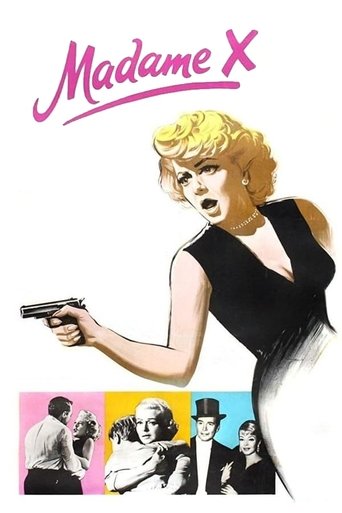
Madame X (1966)
There was always a man... never a name!
Holly Parker, the wife of a wealthy diplomat, is compromised by the accidental death of a man who has been romantically pursuing her. She is forced by her mother-in-law to assume a new identity in order to save the reputation of her husband and infant son. She wanders the world, trying to forget her heartbreak with the aid of alcohol and unsavory men. Eventually returning to the city of her downfall, she murders a blackmailer who threatens to expose her past. Amazingly, Holly is represented at her murder trial by her now adult son, who has become a public defender. In the hope of protecting her family, she refuses to reveal her real name and is known to the court as "Madame X".
- Date of release
- 1966-02-25
- TMDB
- 6.5 / 10 (45)
- Runtime
- 1h 40m
- Genres
- Drama
- Director
- David Lowell Rich
Casting
- Lana Turner — Holly Parker
- John Forsythe — Clay Anderson
- Ricardo Montalban — Phil Benton
- Burgess Meredith — Dan Sullivan
- Constance Bennett — Estelle
- Keir Dullea — Clay Anderson Jr.
- John van Dreelen — Christian Torben
- Carl Benton Reid — Judge
- Virginia Grey — Mimsy
- Warren Stevens — Michael Spalding
- Teddy Quinn — Young Clay Anderson Jr.
- Frank Maxwell — Dr. Evans
Interesting facts
- Filmed in: Playboy Mansion
Madame X is a 1966 American suspense drama film directed by David Lowell Rich and starring Lana Turner, John Forsythe, Ricardo Montalbán, Burgess Meredith, Constance Bennett, and Keir Dullea. Based on the 1908 play of the same name by French playwright Alexandre Bisson, it follows Holly Anderson, the wife of a wealthy American diplomat who, under the pressure of her mother-in-law, fakes her death after the demise of her lover. Holly spends the following fifteen years abroad under a false identity before becoming embroiled in a legal battle after she commits a murder, during which she is unknowingly represented by the son—now a successful attorney—whom she was forced to abandon.
Production
Producer Ross Hunter, who had enjoyed great success remaking projects, had long been interested in bringing the Bisson play to the screen, but Metro-Goldwyn-Mayer (MGM), which had produced film adaptations in 1929 and 1937, owned the rights. After reading the play again at a bookstore, Hunter became enthusiastic again. "I knew that if I kept the trial scene and brought the rest up to date I'd have something," he said.
Hunter announced the film in May 1962 as part of a slate of six projects, also including The Thrill of It All, The Chalk Garden, If a Man Answers, a new Tammy film and a remake of The Dark Angel. The script was written by Jean Holloway, who had written for Hunter in radio, despite the fact that the play had been enacted many times before. "You really have to tell a whole new story," said Holloway.
In October 1962, Hunter said that he hoped that Douglas Sirk would direct, but Sirk declined due to his ailing health. Instead, television director David Lowell Rich was hired to direct the film.
Lana Turner, who had previously made Imitation of Life and Portrait in Black for Hunter, was enlisted as the film's star from the beginning. "Tearjerkers are more difficult to make than any other type of movie," said Hunter. "Critics would seem to categorize them and look down on them; it is word of mouth that is their best press agent. It's all very sad in a way; maybe this is why we're not building great woman stars for audiences today.
Hunter signed a seven-year contract with Universal in November 1964, with Madame X among the leading projects. In February 1965, Keir Dullea's casting was announced. Gig Young was offered the older male lead but asked for too much money, so Hunter hired John Forsythe. The role of Estelle Anderson, Holly's mother-in-law, was originally offered to Madeleine Carroll, though Constance Bennett was ultimately cast in the part.
Read on Wikipedia · Text from Wikipedia, CC BY-SA 4.0. Data from Wikidata.
Recommended
- The File on Thelma Jordon 1949 · ★ 6.5
- I Confess 1953 · ★ 7.1
- The Burning Bed 1984 · ★ 6.9
- The Prowler 1951 · ★ 6.8
- Woman of Straw 1964 · ★ 6.2
- Losing Isaiah 1995 · ★ 6.5
- The Pumpkin Eater 1964 · ★ 6.6
- Killer's Kiss 1955 · ★ 6.3
- Mommie Dearest 1981 · ★ 6.4
- Witness for the Prosecution 1957 · ★ 8.2
- The Girl in the Book 2015 · ★ 5.8
- Dark City 1950 · ★ 6.5