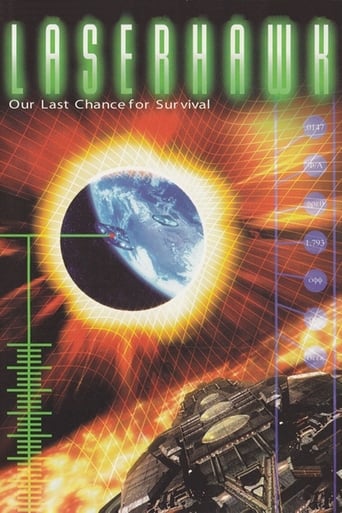
Laserhawk (1997)
250 million years ago, a carnivorous species 'planted' a crop of humans on an uninhabited planet known as Earth. Now, the alien life form has returned to harvest its yield. With total destruction looming just moments away, a futuristic warrior and a prophetic mental patient join forces against the creatures, but with mortal weapons no match for the superior alien technology, the duo's only hope for victory lies in finding a 250 million year-old spaceship known as Laserhawk. The future of the world depends on it.
- Date of release
- 1997-01-29
- TMDB
- 4.6 / 10 (16)
- Runtime
- 1h 39m
- Genres
- Action, Adventure, Science Fiction
- Director
- Jean Pellerin
Casting
- Jason James Richter — Zach Raymond
- Melissa Galianos — Cara
- Gordon Currie — M. K. Ultra
- Mark Hamill — Bob Sheridan
- Ivan Rogers — Col. Lewis Teagarden USAF
- Joseph Wynne — Roach
- Richard Zeman — Frank Raymond
- Susan Almgren — Mrs. Raymond
- A.J. Cook — Pretty Girl #1
- Aimée Castle — Tracy Altergot
- Larry Day — Captain Moss
- Bruce Dinsmore — Freddie
Interesting facts
Laserhawk is a 1998 Canadian science fiction film directed by Jean Pellerin and starring Jason James Richter, Melissa Galianos, Gordon Currie and Mark Hamill. It concerns two teenagers who must team up with a comic book writer and a mental patient to save mankind from destruction at the hands of aliens. More ambitious than the average Canadian-shot genre film at the time, it had a troubled production and only saw a late, small screen release.
Production
The film was the brainchild of Vancouver-based John Curtis of fledgling producer/distributor Everest Pictures. However, Vancouver was becoming too expensive for the project. Toronto-based Greenlight Communications, a feature film newcomer which had acquired a stake in Everest, brokered a co-production deal with another of its affiliated companies, Peter Kroonenburg's Kingsborough Pictures of Montreal.
Laserhawk was originally budgeted at CAD$3 million, and set to begin filming in December 1995. No cast was announced but Quebec-born director Jean Pellerin, a heavy metal music video director, was already attached in his feature debut. He was joined by his usual cinematographer, Eric Moynier. The film was eventually delayed to late May 1996.
Principal photography was scheduled between June 4 and July 13, 1996, in the neighboring towns of Saint-Jean-sur-Richelieu and Iberville, Quebec. It was the first film shot there since Bolt in 1993. By production time, the budget was estimated between CAD$4.5 million and 5.2 million. The production contracted 500 to 600 persons overall, of which the core crew comprised about 75 people. It worked five-day weeks for a projected 30 working days.
Locations spanned various local landmarks such as the Park Lane Café, the Grand Bernier district, the Market Place, Gouin Bridge, rue Richelieu, Armand Racicot Comprensive School and Iberville's 12th Avenue. Historic military sites, the Fort Saint-Jean campus and Saint-Jean Garrison, were also put to use. A disused, now demolished factory ensemble formerly occupied by the Balmet and Singer companies was used for interior sets.
During filming, local auto shop owner Réal Hamel was asked if he could paint four vehicles for the next day. He did, and wound up becoming one of Canada's go-to vehicle coordinators as a result of this impromptu request. At the end of the first week, a DAT recorder was stolen at a high school used by the production, causing the loss of a day's worth of audio.
Read on Wikipedia · Text from Wikipedia, CC BY-SA 4.0. Data from Wikidata.
Recommended
- Osiris 2025 · ★ 6.1
- Extinction 2018 · ★ 6.1
- Batman and Superman: Battle of the Super Sons 2022 · ★ 7.6
- Occupation: Rainfall 2020 · ★ 6.2
- The 5th Wave 2016 · ★ 5.9
- Oblivion 2013 · ★ 6.7
- Man of Steel 2013 · ★ 6.7
- Guardians of the Galaxy 2014 · ★ 7.9
- Ick 2025 · ★ 6.0
- Stargate: Continuum 2008 · ★ 7.1
- Star Trek Into Darkness 2013 · ★ 7.3
- The Adventures of Buckaroo Banzai Across the 8th Dimension 1984 · ★ 6.0