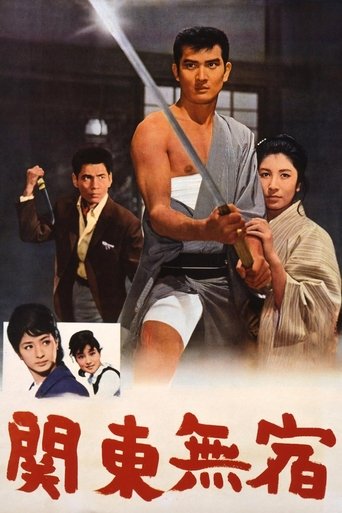
Kanto Wanderer (1963)
関東無宿
Handsome young Katsuta tries to follow the yakuza code, but even his boss doesn't believe in it. Diamond Fuyu is less ethical, and allows the idiotic Tetsu to trick a schoolgirl he fancies, Hanako, into a type of bonded prostitution. Because of gang conflict, the Izu family (to whom Katsuta belongs) has their last gambling den taken over, and he seeks revenge. This brings him back into contact with a former lover who is also a card trickster - she is also Diamond Fuyu's sister, and is now married to Okaru-Hachi, who has mastered a clever card cheating trick called Okaru, which involves the deft use of mirrors.
- Date of release
- 1963-11-23
- TMDB
- 6.6 / 10 (11)
- Runtime
- 1h 33m
- Genres
- Crime, Drama
- Director
- Seijun Suzuki
Casting
- Akira Kobayashi — Katsuta
- Chieko Matsubara — Tokiko
- Daizaburo Hirata — Diamond no Fuyu
- Hiroko Itō — Tatsuko
- Sanae Nakahara — Yamada Hanako
- Kaku Takashina — Yakami
- Chikako Shin — Ishikawa Matsue
- Eimei Esumi
- Ichiro Kijima — Wakabayashi
- Keisuke Noro — Tetsu
- Hiroshi Kōno — Meguro
- Masuo Kinugasa
Interesting facts
Kanto Wanderer is a 1963 Japanese yakuza film directed by Seijun Suzuki and starring Akira Kobayashi, Chieko Matsubara, Daizaburo Hirata and Hiroko Itō. It was a programme picture produced by the Nikkatsu Company to fill out the second half of a double bill with Shohei Imamura's The Insect Woman. The film was based on a novel by Taiko Hirabayashi and had been previously adapted to the screen as Song from the Underworld (1956) by Suzuki's mentor, Hiroshi Noguchi. The story involves Katsuta, a yakuza member who falls in love and is torn between giri (duty) and ninjo (humanity). The Kanto of the title refers to a large plain on which Tokyo is located.
Production
The Nikkatsu Company assigned Kanto Wanderer to contract director Seijun Suzuki. It was his first ninkyo eiga, or chivalry film. It was also a programme picture, a quickly made, low-budget film, designed to be screened after Shohei Imamura's The Insect Woman. Kanto Wanderer was based on a serial written by Taiko Hirabayashi published in the Asahi Shimbun.
Suzuki accepted the assignment on September 24, 1963, and began location scouting the same day. The studio also assigned matinée idol Akira Kobayashi and Chieko Matsubara to the lead roles. Suzuki and his collaborators had more sway with the remaining parts. They suggested many actress for the role of Tatsuko Iwata, such as Yoshie Mizutani and Yukiji Asaoka, but all were turned down. Suzuki argued frequently with the studio on the subject.
Shooting began on October 5, on location in Shinagawa. Kobayashi appeared on set wearing what Suzuki later described as Brezhnevian artificial eyebrows. A dismayed Asada told Suzuki, "Tell Akira to cut that out." Suzuki suggested they leave them so as not to immediately antagonize Kobayashi and the eyebrows remained.
Read on Wikipedia · Text from Wikipedia, CC BY-SA 4.0. Data from Wikidata.
Recommended
- The Yakuza 1974 · ★ 7.1
- Outrage 2010 · ★ 6.9
- Battles Without Honor and Humanity: Deadly Fight in Hiroshima 1973 · ★ 7.3
- Fireworks 1997 · ★ 7.7
- Female Yakuza Tale 1973 · ★ 6.1
- Maximum Risk 1996 · ★ 5.8
- Graveyard of Honor 2002 · ★ 6.3
- Battles Without Honor and Humanity 1973 · ★ 7.3
- The Outsider 2018 · ★ 6.1
- A Family 2021 · ★ 7.4
- Beyond Outrage 2012 · ★ 7.0
- Bad City 2022 · ★ 6.9