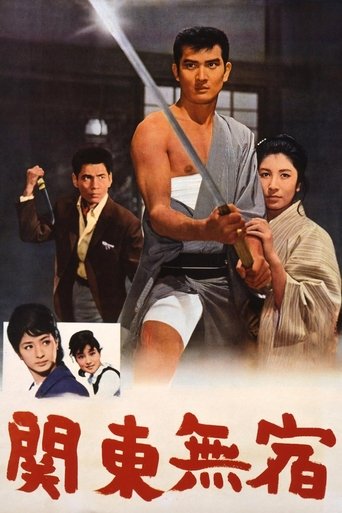
关东浪子 (1963)
関東無宿
伊豆组的干部鹤田光雄,为了要挽回逐渐失去地盘的伊豆组,虽然受到志大的嘉许,却与志大意见不同,其间伊豆组的吉田大龙又欲夺权...。
演员阵容
- 小林旭 — Katsuta
- 松原智惠子 — Tokiko
- 平田大三郎 — Diamond no Fuyu
- 伊藤弘子 — Tatsuko
- 中原早苗 — Yamada Hanako
- 高品格 — Yakami
- 進千賀子 — Ishikawa Matsue
- 江角英明
- 木島一郎 — Wakabayashi
- 野呂圭介 — Tetsu
- 河野弘 — Meguro
- Masuo Kinugasa
趣闻
Kanto Wanderer is a 1963 Japanese yakuza film directed by Seijun Suzuki and starring Akira Kobayashi, Chieko Matsubara, Daizaburo Hirata and Hiroko Itō. It was a programme picture produced by the Nikkatsu Company to fill out the second half of a double bill with Shohei Imamura's The Insect Woman. The film was based on a novel by Taiko Hirabayashi and had been previously adapted to the screen as Song from the Underworld (1956) by Suzuki's mentor, Hiroshi Noguchi. The story involves Katsuta, a yakuza member who falls in love and is torn between giri (duty) and ninjo (humanity). The Kanto of the title refers to a large plain on which Tokyo is located.
Production
The Nikkatsu Company assigned Kanto Wanderer to contract director Seijun Suzuki. It was his first ninkyo eiga, or chivalry film. It was also a programme picture, a quickly made, low-budget film, designed to be screened after Shohei Imamura's The Insect Woman. Kanto Wanderer was based on a serial written by Taiko Hirabayashi published in the Asahi Shimbun.
Suzuki accepted the assignment on September 24, 1963, and began location scouting the same day. The studio also assigned matinée idol Akira Kobayashi and Chieko Matsubara to the lead roles. Suzuki and his collaborators had more sway with the remaining parts. They suggested many actress for the role of Tatsuko Iwata, such as Yoshie Mizutani and Yukiji Asaoka, but all were turned down. Suzuki argued frequently with the studio on the subject.
Shooting began on October 5, on location in Shinagawa. Kobayashi appeared on set wearing what Suzuki later described as Brezhnevian artificial eyebrows. A dismayed Asada told Suzuki, "Tell Akira to cut that out." Suzuki suggested they leave them so as not to immediately antagonize Kobayashi and the eyebrows remained.
在维基百科阅读更多 · 文本来自维基百科,CC BY-SA 4.0。数据来自 Wikidata。
推荐
- 高手 1974 · ★ 7.1
- 极恶非道 2010 · ★ 6.9
- 花火 1997 · ★ 7.7
- 极道女流氓传说:审判与侵略 1973 · ★ 6.1
- 极度冒险 1996 · ★ 5.8
- 大佬 2000 · ★ 7.1
- 外来者 2018 · ★ 6.1
- 西伯利亚教育 2013 · ★ 6.8
- 极道大姐大传说:猪鹿蝶 1973 · ★ 6.2
- 血光光五人帮 1995 · ★ 6.6
- 无仁义之战2:广岛死斗篇 1973 · ★ 7.3
- 黑雨 1989 · ★ 6.6