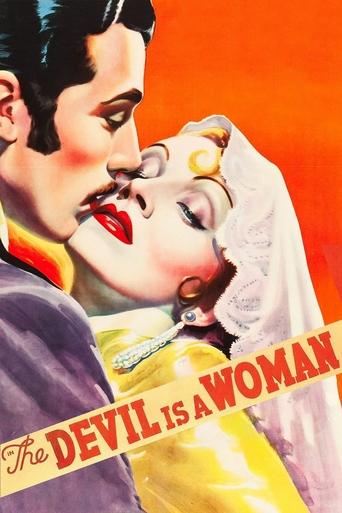
The Devil Is a Woman (1935)
Kiss me .. and I'll break your heart!
In the carnival in Spain in the beginning of the Twentieth Century, the exiled republican Antonio Galvan comes from Paris masquerade to enjoy the party and visit his friend Capt. Don Pasqual 'Pasqualito' Costelar. However, he flirts with the mysterious Concha Perez and they schedule to meet each other later. When Antonio meets Pasqualito, his old friend discloses his frustrated relationship with the promiscuous Concha and her greedy mother and how his life was ruined by his obsession for the beautiful demimondaine. Pasqualito makes Antonio promise that he would not see Concha. However, when Antonio meets Concha, she seduces him and the long friendship between Antonio and Pasqualito is disrupted
- Date of release
- 1935-05-03
- TMDB
- 6.4 / 10 (78)
- Runtime
- 1h 20m
- Genres
- Comedy, Drama, Romance, History
- Director
- Josef von Sternberg
Casting
- Marlene Dietrich — Concha Perez
- Lionel Atwill — Capt. Don Pasqual 'Pasqualito' Costelar
- Edward Everett Horton — Gov. Don Paquito 'Paquitito'
- Alison Skipworth — Senora Perez
- Cesar Romero — Antonio Galvan
- Don Alvarado — Morenito
- Tempe Pigott — Tuerta (as Tempe Piggott)
- Francisco Moreno — Alphonso (as Paco Moreno)
- Max Barwyn — Pablo (uncredited)
- John George — Street Beggar (uncredited)
- Eumenio Blanco — Minor Role (uncredited)
- Eddie Borden — Reveler with Balloon (uncredited)
Interesting facts
- Based on: The Woman and the Puppet
The Devil Is a Woman is a 1935 American romantic drama film directed and photographed by Josef von Sternberg from a screenplay by John Dos Passos, based on the 1898 novel The Woman and the Puppet by Pierre Louÿs. The film stars Marlene Dietrich, Lionel Atwill, and Cesar Romero. It marks the last of the six Sternberg–Dietrich collaborations for Paramount Pictures.
Production
The Devil Is a Woman is the last of Sternberg's seven quasi-autobiographical films featuring his star and muse, Marlene Dietrich. When Sternberg embarked upon filming The Devil Is a Woman, Paramount was experiencing falling profits. His latest film, the lavishly produced The Scarlet Empress, had proved unpopular with the public. Devil was completed on February 6, 1935, premiered without fanfare in March, and released to general audiences in May.
The original title proposed by Sternberg for the film was Caprice Espagnol, a reference to Russian composer Rimsky-Korsakov's orchestral suite Capriccio Espagnol, of which several selections accompany the film. Lubitsch changed the title to The Devil Is a Woman. Sternberg later remarked: "Though Mr. Lubitsch's poetic intention to suggest altering the sex of the devil was meant to aid in selling the picture, it did not do so."
Approximately 17 minutes of footage, including a musical number in which Dietrich sang "If It Isn't Pain (It Isn't Love)", was cut from the film, reducing the total running time to 79 minutes.
Presumed for a time to be a lost film, a copy of the work was provided by Sternberg for a screening at the 20th Venice International Film Festival in 1959, and The Devil Is a Woman received a limited re-release in 1961.
Read on Wikipedia · Text from Wikipedia, CC BY-SA 4.0. Data from Wikidata.
Recommended
- Mayerling 1968 · ★ 6.2
- Désirée 1954 · ★ 6.6
- The Duke 2021 · ★ 6.9
- Love, Classified 2022 · ★ 6.6
- Hitch 2005 · ★ 6.6
- Julia 1977 · ★ 6.5
- What's Love Got to Do with It? 2023 · ★ 6.1
- Raintree County 1957 · ★ 6.4
- Song for Marion 2012 · ★ 6.8
- Madame 2017 · ★ 5.9
- Mrs. Harris Goes to Paris 2022 · ★ 7.3
- Love, Weddings & Other Disasters 2020 · ★ 6.0