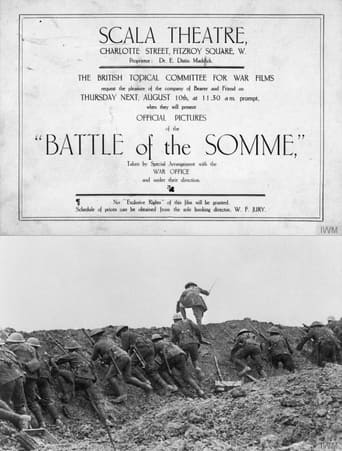
The Battle of the Somme (1916)
A documentary and propaganda film which shows the British Army's preparations for, and the early stages of, the battle of the Somme.
- Date of release
- 1916-08-21
- TMDB
- 6.6 / 10 (24)
- Runtime
- 1h 14m
- Genres
- Documentary, War
- Director
- Geoffrey Malins
Interesting facts
- Filmed in: Beaumont-Hamel
The Battle of the Somme, is a 1916 British documentary and propaganda war film, shot by two official cinematographers, Geoffrey Malins and John McDowell. The film depicts the British Expeditionary Force during the preliminaries and early days of the Battle of the Somme. The film premièred in London on 10 August 1916 and was released generally on 21 August. The film shows trench warfare, marching infantry, artillery firing on German positions, British troops waiting to attack on 1 July, the treatment of wounded British and German soldiers, British and German dead and captured German equipment and positions.
Production
On 2 November 1915, the British Topical Committee for War Films, representing British newsreel producers and supported by the War Office, despatched two cameramen to France. Geoffrey Malins of Gaumont British and Edward Tong of Jury's Imperial Pictures, were to shoot footage for short newsreels.
Malins and McDowell shot the film between 26 June and from 7 to 9 July. Malins filmed in the vicinity of Beaumont Hamel, on attachment with the 29th Division (VIII Corps); McDowell worked further south near Fricourt and Mametz with the 7th Division (XV Corps). Before the battle, Malins worked at the north end of the British Somme sector, photographing troops on the march and heavy artillery west of Gommecourt.
Malins returned to film the speech by de Lisle to the 2nd Royal Fusiliers, after which Malins heard of the postponement of the battle for 48 hours. Malins returned to White City to film the bombardment of the Hawthorn Ridge Redoubt by trench mortars, during which there were three misfires which destroyed a trench-mortar position nearby.
Later in the day, a shell explosion damaged the camera tripod; Malins repaired it and in the evening filmed roll-calls. Next day Malins shot film at La Boisselle before leaving for London around 9 July. Malins returned to France and from 12 to 19 July filmed sequences of shellfire and of troops advancing from trenches, staged for the camera at a Third Army mortar school near St Pol.
On 10 July, Brigadier-General John Charteris reported to the War Office that some 8,000 ft (2,400 m) of footage had been shot and recommended that sections of film should be released as soon as possible. Footage was first viewed as a negative on 12 July and Charles Urban is thought to have begun work on the film as editor, with the assistance of Malins.
Read on Wikipedia · Text from Wikipedia, CC BY-SA 4.0. Data from Wikidata.
Recommended
- They Shall Not Grow Old 2018 · ★ 7.8
- Why We Fight: Prelude to War 1942 · ★ 6.5
- 2000 Meters to Andriivka 2025 · ★ 8.2
- Father Soldier Son 2020 · ★ 6.5
- The Battle of San Pietro 1945 · ★ 6.1
- City of Ghosts 2017 · ★ 7.2
- For Sama 2019 · ★ 8.2
- Trinity and Beyond: The Atomic Bomb Movie 1995 · ★ 7.2
- My Mom Jayne 2025 · ★ 8.0
- The War on Democracy 2007 · ★ 7.5
- Night Will Fall 2014 · ★ 7.6
- Come See Me in the Good Light 2025 · ★ 6.9