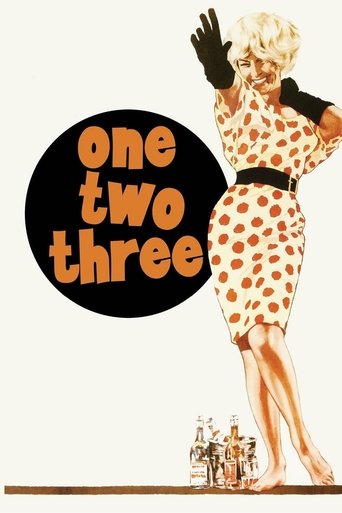
One, Two, Three (1961)
Billy Wilder's Explosive New Comedy
In Cold War-era West Berlin, American Coca-Cola executive C.R. 'Mac' MacNamara is tasked with playing babysitter to his boss' spoiled 17-year-old daughter Scarlett, who proves more difficult than anticipated when she reveals that she is pregnant by a Communist.
- Date of release
- 1961-12-15
- TMDB
- 7.5 / 10 (446)
- Runtime
- 1h 49m
- Genres
- Comedy
- Director
- Billy Wilder
Casting
- James Cagney — C.R. MacNamara
- Horst Buchholz — Otto Ludwig Piffl
- Pamela Tiffin — Scarlett Hazeltine
- Arlene Francis — Phyllis MacNamara
- Liselotte Pulver — Fräulein Ingeborg
- Hanns Lothar — Schlemmer
- Howard St. John — Wendell P. Hazeltine
- Leon Askin — Peripetchikoff
- Ralf Wolter — Borodenko
- Karl Lieffen — Fritz
- Hubert von Meyerinck — Count von Droste Schattenburg
- Loïs Bolton — Melanie Hazeltine
Interesting facts
- Box office: $4M
- Budget: $3M
- Earned 1.3× its budget
- Based on: One two three
- Filmed in: Berlin, Germany, Coca-Cola Niederlassung (Berlin-Lichterfelde), and Bavaria Studios & Production Services
- Awards: 1 · Nominations: 3. Including: National Board of Review: Top Ten Films
One, Two, Three is a 1961 American political comedy film directed by Billy Wilder, and written by Wilder and I. A. L. Diamond. It is based on the 1929 Hungarian one-act play Egy, kettő, három by Ferenc Molnár, with a "plot borrowed partly from" Ninotchka, a 1939 film co-written by Wilder. The film stars James Cagney, Horst Buchholz, Liselotte Pulver, Pamela Tiffin, Arlene Francis, Leon Askin and Howard St. John. It would be Cagney's last film appearance until Ragtime in 1981, 20 years later.
Production
We knew that we were going to have a comedy, we [were] not going to be waiting for the laughs. But we had to go with Cagney, because Cagney was the whole picture. He really had the rhythm, and that was very good. It was not funny. But just the speed was funny ... The general idea was, let's make the fastest picture in the world ... And yeah, we did not wait, for once, for the big laughs.
Cagney decided to take the role primarily because it was to be shot in Germany: while growing up in Manhattan's Yorkville neighborhood, he had had fond memories of the area, which was "teeming with German immigrants." Horst Buchholz was a young European actor who had recently finished The Magnificent Seven with Yul Brynner, Eli Wallach and Steve McQueen; reportedly, to star in the film, he turned down a role in Lawrence of Arabia.
It is very interesting that not until the very end of my career did I meet an unco-operative fellow actor. As I review the pictures I’ve been in, I realize that each and every actor I worked with had a part in shaping my summary views on acting. We all worked together rewardingly with what I hope was mutual enrichment. I never had the slightest difficulty with a fellow actor until the making of One, Two, Three.
Although Tuesday Weld lobbied strongly for the role of Scarlett, the role went to Pamela Tiffin, her second film role following Summer and Smoke, who was chosen after Wilder spotted her in an ad in The New York Times and cast her immediately following her audition. To star in the film, Tiffin dropped out of Frank Capra's Pocketful of Miracles, with her role being reassigned to Ann-Margret.
Wilder was filming in Berlin the morning the Berlin Wall went up, forcing the crew to move to Munich. Interiors were shot at Bavaria Film Studios. Because of issues with East German and Soviet authorities, who allowed Wilder to film on their side of Berlin only after reading the script, a full-size replica of the Brandenburg Gate was built on the back lot at the Bavaria Studios.
Read on Wikipedia · Text from Wikipedia, CC BY-SA 4.0. Data from Wikidata.
Recommended
- Little Murders 1971 · ★ 6.7
- Nine to Five 1980 · ★ 7.0
- Barbie 2023 · ★ 6.9
- Charlie and the Chocolate Factory 2005 · ★ 7.0
- Problemista 2024 · ★ 6.7
- Parental Guidance 2012 · ★ 5.9
- Johnny Dangerously 1984 · ★ 6.3
- Analyze This 1999 · ★ 6.5
- The Phoenician Scheme 2025 · ★ 6.5
- Charlie's Angels 2019 · ★ 6.3
- Yankee Zulu 1993 · ★ 6.2
- Lost in America 1985 · ★ 6.8