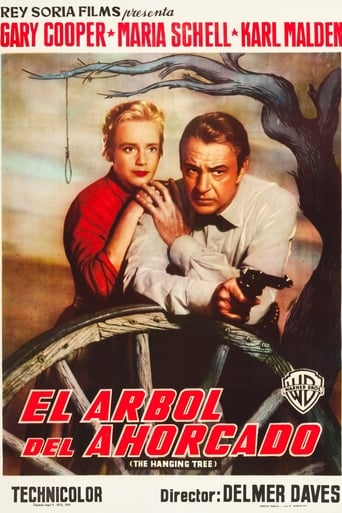
El árbol del ahorcado (1959)
The Hanging Tree
¡Una imagen de poder atronador!
En la época de la fiebre del oro, a un poblado minero de Montana llega Joe Frail (Gary Cooper), un extraño y contradictorio médico sobre el que parece pesar un oscuro pasado. Tras el asalto de unos bandoleros a la diligencia, la única superviviente resulta ser una inmigrante suiza (Maria Schell) que, a causa de una insolación, se queda ciega. De cuidarla hasta que recupera la vista se ocupará Frail.
- Fecha de estreno
- 1959-02-19
- TMDB
- 6.7 / 10 (131)
- Duración
- 1 h 47 min
- Géneros
- Western
- Director
- Delmer Daves
Reparto
- Gary Cooper — Dr. Joseph "Doc" Frail
- Maria Schell — Elizabeth Mahler
- Karl Malden — Frenchy Plante
- George C. Scott — George Grubb
- Karl Swenson — Tom Flaunce
- Virginia Gregg — Edna Flaunce
- John Dierkes — Society Red
- King Donovan — Wonder
- Ben Piazza — Rune
- Emile Avery — Townsman (uncredited)
- Fern Barry — Mother (uncredited)
- William Benedict — Trapper (uncredited)
Curiosidades
The Hanging Tree is a 1959 American Western film directed by Delmer Daves, based on the novelette The Hanging Tree, written by Dorothy M. Johnson in 1957. The film stars Gary Cooper, Maria Schell, Karl Malden and George C. Scott, and it is set in the gold fields of Montana during the gold rush of the 1860s and 1870s. The story follows a doctor who saves a criminal from a lynch mob, then earns the enmity of several prospectors while trying to protect a young woman whom he has nursed back to health after she was injured in a coach robbery. Karl Malden assumed directing duties for several days when Daves fell ill, and the film represented the first cinematic appearance for George C. Scott.
Production
The film was the first one for Cooper's Baroda Productions company. It was the first film produced by former talent agents Martin Jurow and Richard Shepherd.
Wendell Mayes said "it was the only western that I think that I've ever seen that was a woman's film rather than a man's film—Maria Schell playing the blind heroine was marvelous."
Principal photography was shot on location in the Oak Creek Wildlife Area in the mountains west of Yakima, Washington. The scenes during the opening credits and title, where Gary Cooper rides alongside the river on horseback with a pack horse in tow, were filmed about mid-June in 1958, just northeast of Goose Prairie, Washington, along the north bank of the Bumping River.
The cinematography by Ted McCord made use of full-aperture photography and reduction printing to improve the grain quality of the film. This process involves widening the aperture of the camera to capture a larger image, then reducing the image back to standard size in post-production.
Leer en Wikipedia · Texto de Wikipedia, CC BY-SA 4.0. Datos de Wikidata.
Recomendadas
- El Vengador Sin Piedad 1958 · ★ 6.6
- A través del huracán 1966 · ★ 6.2
- El rebelde orgulloso 1958 · ★ 6.0
- Arizona 1939 · ★ 7.2
- Llamando a las puertas del cielo 2005 · ★ 6.2
- Los hermanos Marx en el oeste 1940 · ★ 6.6
- Estación Comanche 1960 · ★ 6.7
- El forastero 1940 · ★ 7.1
- El gran McLintock 1963 · ★ 6.6
- El sargento negro 1960 · ★ 7.0
- Espíritu de conquista 1941 · ★ 6.0
- Los valientes andan solos 1962 · ★ 7.4