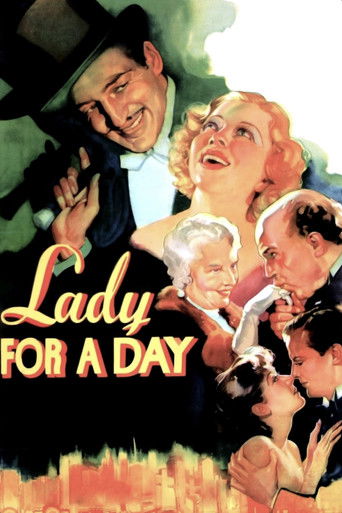
Lady for a Day (1933)
Takes its place among the greatest pictures ever made!
Apple Annie is an aging New York City fruit seller whose daughter Louise has been raised in a Spanish convent since she was an infant. As she grows up, Louise is led to believe that her mother is a society matron called Mrs. E. Worthington Manville. Annie worries that her lie is in danger of being uncovered when she learns that Louise is sailing to New York with her new fiancé and his nobleman father.
- Date of release
- 1933-09-13
- TMDB
- 7.1 / 10 (99)
- Runtime
- 1h 36m
- Genres
- Comedy, Drama
- Director
- Frank Capra
Casting
- Warren William — Dave the Dude
- May Robson — Apple Annie
- Guy Kibbee — Judge Henry G. Blake
- Glenda Farrell — Missouri Martin
- Ned Sparks — Happy McGuire
- Walter Connolly — Count Romero
- Jean Parker — Louise
- Nat Pendleton — Shakespeare
- Barry Norton — Carlos
- Halliwell Hobbes — Butler
- Hobart Bosworth — Governor
- Robert Emmett O'Connor — Inspector MacCreary
Interesting facts
- Awards: 0 · Nominations: 4
Lady for a Day is a 1933 American pre-Code comedy-drama film directed by Frank Capra. The screenplay by Robert Riskin is based on the 1929 short story "Madame La Gimp" by Damon Runyon. It was the first film for which Capra received an Academy Award nomination for Best Director and the first Columbia Pictures release to be nominated for Best Picture. Capra also directed its 1961 remake, Pocketful of Miracles.
Production
Damon Runyon's short story Madame La Gimp was published in the October 1929 issue of Cosmopolitan. Columbia Pictures purchased the screen rights in September 1932, and the studio scheduled the production to begin the following May, although director Frank Capra had misgivings about the project.
Riskin had written his screenplay specifically for Robert Montgomery, but MGM refused to loan him to Columbia. He was among several performers Capra wanted but failed to secure for roles in the film. With Montgomery unavailable, Capra approached James Cagney and William Powell, but Warner Bros. refused to loan them out to work on this project. Capra's first choices for Apple Annie and Henry G. Blake, Marie Dressler and W.C.
One week before filming began, Capra offered the role of Apple Annie to 75-year-old May Robson, most of whose career had been spent performing on stage. In later years, Capra thought the fact she and most of the supporting players were unfamiliar to movie audiences helped the public accept them as the down-on-their-luck characters they were meant to be.
Just prior to the first preview in Hollywood in early July 1933, the film's title was changed from Madame La Gimp to Beggars' Holiday, then changed again before the film premiered at Radio City Music Hall on September 7. It went into general release on September 13 and within a very short time earned $600,000, twice its budget and a substantial sum for the period.
In the early 1950s, the original negative was lost while being transferred from one film lab to another for preservation work. For a period of time the only existing copy was a 35mm print owned by Capra, until he made a duplicate negative from it and donated a newly minted print to the Library of Congress.
Read on Wikipedia · Text from Wikipedia, CC BY-SA 4.0. Data from Wikidata.
Recommended
- Pocketful of Miracles 1961 · ★ 7.3
- Mrs. Doubtfire 1993 · ★ 7.2
- Mildred Pierce 1945 · ★ 7.6
- Liar Liar 1997 · ★ 6.7
- Bringing Down the House 2003 · ★ 6.0
- The Women 1939 · ★ 7.2
- Sons of the Desert 1933 · ★ 7.1
- Uptown Girls 2003 · ★ 7.1
- Miracle on 34th Street 1947 · ★ 7.4
- Big Fish 2003 · ★ 7.7
- Freaky Friday 2003 · ★ 6.6
- Roald Dahl's Matilda the Musical 2022 · ★ 6.8