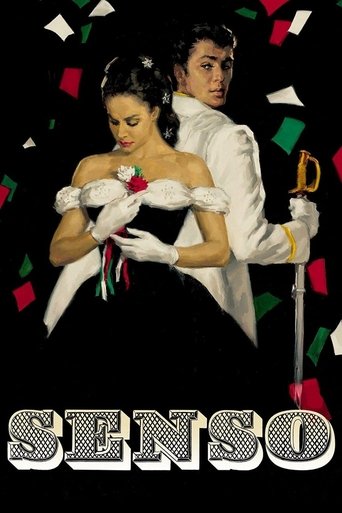
Senso (1954)
A troubled and neurotic Italian Countess betrays her entire country for a self-destructive love affair with an Austrian Lieutenant.
- Data lansării
- 1954-03-25
- TMDB
- 7.2 / 10 (260)
- Durată
- 2 h 3 min
- Genuri
- Romantic, Dramă, Război
- Regizor
- Luchino Visconti
Distribuție
- Farley Granger — Il Tenente Franz Mahler
- Alida Valli — La Contessa Livia Serpieri
- Massimo Girotti — Il Marchese Roberto Ussoni
- Heinz Moog — Il Conte Serpieri
- Rina Morelli — Laura, la Governante
- Christian Marquand — Un Ufficiale Boemo
- Sergio Fantoni — Luca
- Tino Bianchi — Il Capitano Meucci
- Ernst Nadherny — Il Comandante della Piazza di Verona
- Tonio Selwart — Il Colonello Kleist
- Marcella Mariani — Clara, la Prostituta
- Franco Arcalli — Un Soldato (uncredited)
Curiozități
- Filmat în: Veneția
Senso is a 1954 Italian historical melodrama film directed and co-written by Luchino Visconti, based on Camillo Boito's novella of the same name. Set during the Third Italian War of Independence, the film follows the Italian Contessa Livia Serpieri, who has an affair with the Austrian Lieutenant Franz Mahler. It was Visconti's first color film.
Production
Boito's novella is presented as though it is the private diary of Countess Livia (who is not from Venice, as she is in the film, but, rather, from Trento). Sixteen years after the Third Italian War of Independence, she tells of being courted on and off by a lawyer, Gino, whom she constantly rebuffs, and then reminisces about an affair she had in Venice in 1866, and the story switches back and forth between the present and past, with the past comp…
The film has a greater focus on the War than the novella, and the character of Roberto Ussoni, Livia's nationalist cousin who leads a rebellion against the Austrians, is original to the film. The episode in which Livia gives the money meant for the Italian partisans to her lover, leading to a dramatic massacre, is also not in Boito's story.
The character of Remigio Ruz in the novella was renamed Franz Mahler for the film. Visconti changed the name as a tribute to Gustav Mahler, one of his favourite composers, whose music features prominently in his later film Death in Venice (1971). Another musical aspect of the film that was added to the story is the opening, which takes place during an opera (in Boito's novella, the protagonists first meet at a swimming bath).
Originally, Visconti had hoped to cast Ingrid Bergman and Marlon Brando in the lead roles. However, at the time, Bergman was married to Italian director Roberto Rossellini, who would not allow her to work for other directors, and Brando was rejected by the producers, who considered Granger to be a bigger star. It has also been said that Brando refused the role after being informed that Bergman was not going to participate in the film.
In his autobiography, Tab Hunter claimed Visconti considered him to play Mahler, but his agent didn't tell him because he thought foreign films were a waste of time.
Citește pe Wikipedia · Text din Wikipedia, CC BY-SA 4.0. Date din Wikidata.
Recomandate
- Anna Karenina 1997 · ★ 6.1
- Come Undone 2010 · ★ 5.9
- O zi specială 1977 · ★ 8.1
- Anonimul venețian 1970 · ★ 7.5
- Three Coins in the Fountain 1954 · ★ 5.9
- Mayerling 1968 · ★ 6.2
- Captain Corelli's Mandolin 2001 · ★ 5.9
- Anna Karenina 2012 · ★ 6.7
- Tristan și Isolda 2006 · ★ 6.7
- Ducesa 2008 · ★ 7.0
- The Scarlet and the Black 1983 · ★ 7.1
- Vârsta inocenței 1993 · ★ 7.0