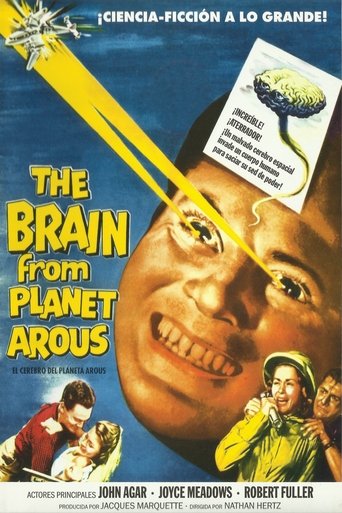
El Cerebro del Planeta Arous (1957)
The Brain from Planet Arous
Un científico es poseído por Gor, un cerebro alienígena (con ojos y que vapulea gente y vuela gracias a unos alambres de acero que usted no debería divisar, pero que puede llegar a hacerlo en ciertas escenas). Gor intenta dominar el planeta Tierra, entre otros propósitos muchos más descabellados. En tanto, George, el perro de Sally, la bonita novia del protagonista, es poseído por Fol, otro cerebro extraterrestre que viene persiguiendo al cerebro malo.
- Fecha de estreno
- 1957-12-26
- TMDB
- 5.1 / 10 (50)
- Duración
- 1 h 11 min
- Géneros
- Terror, Ciencia ficción
- Director
- Nathan Juran
Reparto
- John Agar — Steve March
- Joyce Meadows — Sally Fallon
- Robert Fuller — Dan Murphy
- Thomas Browne Henry — John Fallon
- Henry Travis — Colonel Frogley
- E. Leslie Thomas — General Brown
- Tim Graham — Sheriff Wiley Pane
- Bill Giorgio — Russian
- Ken Terrell — Colonel in Conference Room
- Dale Tate — Professor/voices of Gor & Vol (uncredited)
Curiosidades
The Brain from Planet Arous is a 1957 independently made American black-and-white science fiction film, produced by Jacques R. Marquette, directed by Nathan H. Juran, that stars John Agar, Joyce Meadows, and Robert Fuller. It was written by Ray Buffum. The film was released on December 26, 1957, by Howco International on a double feature with Teenage Monster (1957).
Production
The special effect for Agar's eyes was achieved by using contact lenses lined with metal foil. These were used a decade later by actor Gary Lockwood during the second Star Trek TV series pilot episode "Where No Man Has Gone Before".
Stock footage of unoccupied houses being flash-incinerated in above-ground atomic bomb tests was used to demonstrate Gor's psychic powers.
The plot of an alien interstellar policeman pursuing a dangerous, space-faring criminal who must slip into and possess the bodies of Earth lifeforms is similar to the classic science fiction novel Needle by Hal Clement that was first published in 1949 as a multi-part serial in Astounding Science Fiction magazine. The 1987 film The Hidden also shares similar story elements without being a direct adaptation of Clement's novel.
Director Nathan Juran was unhappy with the final film and changed his screen credit to the pseudonym "Nathan Hertz".
Leer en Wikipedia · Texto de Wikipedia, CC BY-SA 4.0. Datos de Wikidata.
Recomendadas
- El esqueleto prehistórico 1973 · ★ 5.8
- Infiltrado 2001 · ★ 6.1
- Eternal 2015 · ★ 6.4
- La huésped 2013 · ★ 6.3
- Sucesos en la IV fase 1974 · ★ 6.3
- El sueño oscuro 1956 · ★ 6.2
- Los invasores de Marte 1953 · ★ 5.9
- Signal One 2026 · ★ 6.0
- El día de la revelación 2026 · ★ 7.4
- Autómata 2014 · ★ 5.9
- The Creator 2023 · ★ 7.0
- Los sustitutos 2009 · ★ 6.2