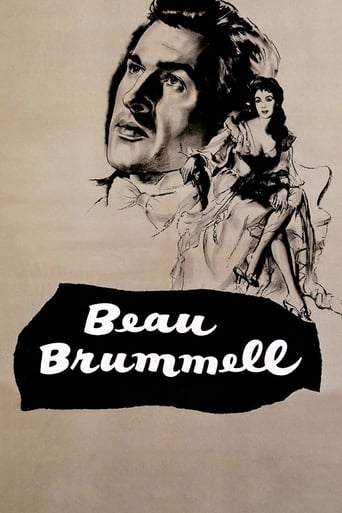
Beau Brummell (1954)
Soldier, poet, adventurer, rogue, gambler, lover !
Captain George Bryan Brummell is a British soldier who appreciates fine clothing and innovative dress. Although he initially alienates the Prince of Wales with insulting comments about the prince's uniform designs, he eventually becomes his close confidant. Brummel also falls in love with the beautiful Lady Patricia Belham. However, his outspoken manner eventually leads to his being exiled to France.
- Date of release
- 1954-11-16
- TMDB
- 6.5 / 10 (35)
- Runtime
- 1h 53m
- Genres
- Drama, History, Romance
- Director
- Curtis Bernhardt
Casting
- Stewart Granger — Beau Brummell
- Elizabeth Taylor — Lady Patricia
- Peter Ustinov — George, Prince of Wales
- Robert Morley — King George III
- James Donald — Lord Edwin Mercer
- James Hayter — Mortimer
- Rosemary Harris — Mrs. Fitzherbert
- Paul Rogers — William Pitt
- Noel Willman — Lord Byron
- Peter Dyneley — Midger
- Charles Carson — Sir Geoffrey Baker
- Ernest Clark — Dr. Warren
Interesting facts
Beau Brummell is a 1954 British historical film released by Metro-Goldwyn-Mayer. It was directed by Curtis Bernhardt and produced by Sam Zimbalist from a screenplay by Karl Tunberg, based on the 1890 play Beau Brummell by Clyde Fitch. The play was previously adapted as a silent film made in 1924 and starring John Barrymore as Beau Brummell, Mary Astor, and Willard Louis as the Prince of Wales.
Production
Clyde Fitch's play was written in 1890 as a vehicle for Richard Mansfield.
In 1946, there was plans to make a British film about Brummel, which never materialized.
In March 1951, MGM announced they would make a film from Fitch's play as a vehicle for Stewart Granger, who had starred in King Solomon's Mines (1950) for the studio and been signed to a long-term contract. The producer would be Sam Zimbalist, who produced Mines. It was to follow the filming of The Light Touch. In June John Lee Mahin was assigned to write the script.
Filming was pushed back to enable Granger to make other films including Scaramouche, The Prisoner of Zenda (both 1952), All the Brothers Were Valiant, Young Bess (both 1953), and Robinson Crusoe. (The last project was not made).
In January 1953, Hedda Hopper announced the film would star Granger and Eleanor Parker who had just teamed successfully on Scaramouche. In April, Deborah Kerr was announced.
Read on Wikipedia · Text from Wikipedia, CC BY-SA 4.0. Data from Wikidata.
Recommended
- The Young Victoria 2009 · ★ 7.2
- Lovely, Still 2009 · ★ 6.6
- Kitty Foyle 1940 · ★ 6.6
- Mayerling 1968 · ★ 6.2
- Désirée 1954 · ★ 6.6
- The Lost Husband 2020 · ★ 6.7
- Far from the Madding Crowd 1967 · ★ 6.9
- The Secret: Dare to Dream 2020 · ★ 7.4
- The Magic of Ordinary Days 2005 · ★ 7.5
- Pride and Prejudice 1940 · ★ 6.9
- That Hamilton Woman 1941 · ★ 7.1
- The Sleeping Dictionary 2003 · ★ 6.6