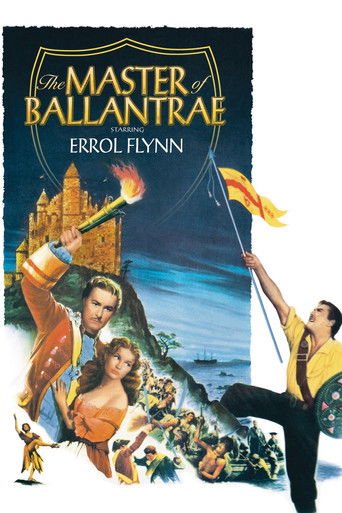
The Master of Ballantrae (1953)
The Thundering Crusaders of the White Cockade!
Scottish highlander Jamie Durie falls into a life of piracy after joining the failed rebellion of Bonnie Prince Charlie against the British crown.
- Date of release
- 1953-08-05
- TMDB
- 6.0 / 10 (33)
- Runtime
- 1h 30m
- Genres
- Adventure
- Director
- William Keighley
Casting
- Errol Flynn — Jamie Durie
- Roger Livesey — Col. Francis Burke
- Anthony Steel — Henry Durie
- Beatrice Campbell — Lady Alison
- Yvonne Furneaux — Jessie Brown
- Felix Aylmer — Lord Durrisdeer
- Mervyn Johns — MacKellar
- Charles Goldner — Capt. Mendoza
- Ralph Truman — Clarendon
- Francis de Wolff — Matthew Bull
- Jacques Berthier — Capt. Arnaud
- Gillian Lynne — Marianne (uncredited)
Interesting facts
- Based on: The Master of Ballantrae
- Filmed in: Palermo
The Master of Ballantrae is a 1953 British Technicolor swashbuckler adventure film starring Errol Flynn and Roger Livesey. It is a loose and highly truncated adaptation of the Robert Louis Stevenson 1889 novel of the same name. In eighteenth century Scotland, two sons of a laird clash over the family estate and a lady. It was the last film directed by William Keighley.
Production
Walker Whiteside toured the US with a play version of the novel in 1935.
Warner Bros. Pictures purchased the screen rights to the novel in 1950. The novel was in the public domain in the US but still in copyright in certain European countries. The purchase was made with funds "frozen" by the British government i.e. money earned by Warners in Britain which they could not take out of the country.
Warner Bros. announced on 7 September 1950 that they would make the film, with shooting to take place in England. (Warners had just made another sea-faring tale, Captain Horatio Hornblower, in England.) The following year it was announced that Joe Gottesman would be producer and Herb Meadow was doing the adaptation. In 1952 it was announced that Errol Flynn would star and the film would be known as The Sea Rogue.
The film was shot in Great Britain in 1952 from June 25 through to August, with location work in Cornwall and the Scottish Highlands with the pirate sequences done in Palermo in Sicily. Shooting took place six days a week.
Fencing champion Sgt Robert Anderson from the (British) Royal Marines went on leave to participate in the film.
Read on Wikipedia · Text from Wikipedia, CC BY-SA 4.0. Data from Wikidata.
Recommended
- Rob Roy 1995 · ★ 6.7
- Swashbuckler 1976 · ★ 6.2
- Treasure Island 1950 · ★ 6.5
- Jamaica Inn 1939 · ★ 6.1
- Pirates of the Caribbean: The Curse of the Black Pearl 2003 · ★ 7.8
- The Eagle 2011 · ★ 6.2
- Mutiny on the Bounty 1935 · ★ 7.4
- A High Wind in Jamaica 1965 · ★ 6.3
- Unconquered 1947 · ★ 6.5
- The Crimson Pirate 1952 · ★ 7.0
- Pirates of the Caribbean: At World's End 2007 · ★ 7.3
- Anne of the Indies 1951 · ★ 6.4