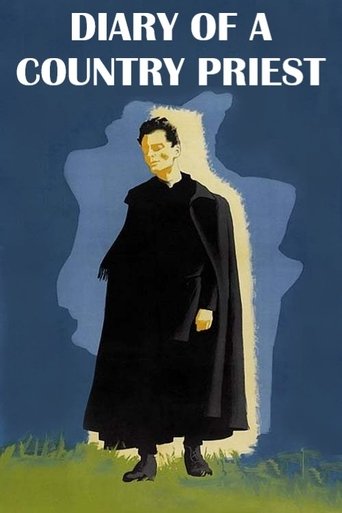
Diary of a Country Priest (1951)
Journal d'un curé de campagne
A priest of humble origin, lost in the maze of worldiness
An inexperienced, sickly priest shows up in the rural French community of Ambricourt, where he joins the community's clergy. But the locals don't take kindly to the priest, and his ascetic ways and unsociable demeanor make him an outcast. During Bible studies at the nearby girls school, he is continually mocked by his students. Then his attempt to intervene in a family feud backfires into a scandal. His failures, compounded with his declining health, begin to erode his faith.
- Date of release
- 1951-02-07
- TMDB
- 7.5 / 10 (296)
- Runtime
- 1h 55m
- Genres
- Drama
- Director
- Robert Bresson
Casting
- Claude Laydu — Curé d'Ambricourt
- Jean Riveyre — Le Comte
- Adrien Borel — Priest of Torcy
- Rachel Bérendt — La Comtesse
- Nicole Maurey — Miss Louise
- Nicole Ladmiral — Chantal
- Martine Lemaire — Séraphita Dumontel
- Antoine Balpêtré — Dr. Delbende
- Jean Danet — Olivier
- Gaston Séverin — Canon
- Yvette Etiévant — Femme de Ménage
- Bernard Hubrenne — Prêtre Dufrety
Interesting facts
- Based on: The Diary of a Country Priest
- Awards: 1 · Nominations: 0. Including: Louis Delluc Prize
Diary of a Country Priest is a 1951 French drama film written and directed by Robert Bresson. The film stars Claude Laydu in his feature film debut. A faithful adaptation of Georges Bernanos' Grand Prix du Roman-winning novel of the same name, the film tells the story of a sickly young Catholic priest who has been assigned a small village in northern France as his first parish. The film illustrates the eroding religious faith in the French countryside and the clergy's struggles to reach younger believers disillusioned by the inflexibility, and sometimes hypocritical flexibility, of the Church at the time.
Production
At one point, screenwriters Jean Aurenche and Pierre Bost wrote an adaptation of the novel, but author Georges Bernanos rejected their draft. François Truffaut reviewed the Aurenche-Bost draft and concluded that it was unfaithful to both the letter and spirit of the novel. For example, the draft screenplay does not end with "All is grace," and omits the character of Dr.
Bresson did not write his screenplay until after Bernanos was dead, and said he would have deviated more from the novel if Bernanos had still been alive, which Truffaut interpreted to mean that Bresson intended to be faithful to the novel's spirit but would have solicited Bernanos' input on certain modifications (that is, "inventing without betraying").
In the film, Bresson cast some non-professional actors, which is a practice he would expand upon in his subsequent films. His direction of these amateurs, who he referred to as "models", purposely constrained their movements and expressions, as he believed the performers' emotive lack would leave greater room for response in the audience.
The film was Bresson's first to utilize a complex soundtrack and voice-over narration. Its dialogue, which frequently consists of debates on spiritual and ethical matters, is complemented by voice-over commentary drawn from the diary after which the film is titled. Bresson stated that "an ice-cold commentary can warm, by contrast, tepid dialogues in a film.
French journalist Frédéric Bonnaud praised Bresson's minimalist approach to the film's setting and argued: "For the first time in French cinema, the less the environment is shown, the more it resonates [...] ubiquitous and constant, persistent and unchanging, it doesn’t need to be shown: its evocation through sound is enough. It’s a veritable prison."
Read on Wikipedia · Text from Wikipedia, CC BY-SA 4.0. Data from Wikidata.
Recommended
- The Keys of the Kingdom 1944 · ★ 7.1
- Fatima 2020 · ★ 7.2
- The Left Hand of God 1955 · ★ 6.3
- The Bookshop 2017 · ★ 6.5
- The Shoes of the Fisherman 1968 · ★ 6.8
- Bloody Milk 2017 · ★ 6.9
- Come Sunday 2018 · ★ 5.8
- Soul on Fire 2025 · ★ 7.4
- The Dazzled 2019 · ★ 6.9
- The Minister 2011 · ★ 6.4
- Boomerang! 1947 · ★ 7.0
- The Way West 1967 · ★ 6.1