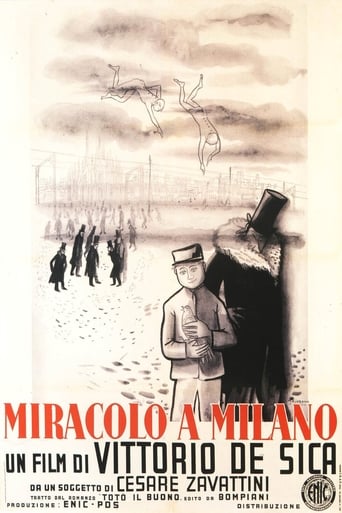
Miracol la Milano (1951)
Miracolo a Milano
Un râs obraznic și răvășit asupra vieților și moralei zilelor noastre!
Mătușa Lolotta, care locuiește singură, găsește într-o zi un băiețel care plânge printre frunzele de varză. Îl crește cu dragoste, dar, din păcate, ea moare curând. Micul Toto crește în orfelinat, iar când iese de acolo, drumul lui duce direct către cei săraci care locuiesc în zona Milano. Toto nu renunță însă. Cu bună dispoziție și optimism, el îi convinge curând pe locuitorii colibelor să construiască clădiri mici și îngrijite în locul colibelor. Totul ar merge bine, dar deodată petrolul iese din pământ și imediat există cineva interesat de această „comoară”, dar bineînțeles că nu vrea să o împartă cu oamenii săraci. Dar Toto, băiatul capabil să facă „miracole”, stă alături de oameni...
- Data lansării
- 1951-02-08
- TMDB
- 7.3 / 10 (276)
- Durată
- 1 h 32 min
- Genuri
- Comedie, Fantasy, Dramă
- Regizor
- Vittorio De Sica
Distribuție
- Emma Gramatica — La vecchia Lolotta
- Francesco Golisano — Totò
- Paolo Stoppa — Rappi
- Guglielmo Barnabò — Mobbi
- Brunella Bovo — Edvige
- Anna Carena — Marta, la signora altezzosa
- Alba Arnova — La statua che prende vita
- Flora Cambi — L'innamorata infelice
- Virgilio Riento — Il sergente delle guardie
- Arturo Bragaglia — Alfredo
- Erminio Spalla — Gaetano
- Riccardo Bertazzolo — L'atleta
Curiozități
- Filmat în: Milano
Miracle in Milan is a 1951 Italian fantasy comedy film directed by Vittorio De Sica. The screenplay was co-written by Cesare Zavattini and De Sica, based on Zavattini's 1943 novel Totò il Buono. Told as a neo-realist fable, the film depicts the lives of a poverty-stricken group in post-WWII Milan, Italy, led by Totò, a kind and cheerful orphan. The film stars Francesco Golisano as Totò, alongside an ensemble cast that includes Emma Gramatica, Paolo Stoppa, Guglielmo Barnabò, and Brunella Bovo.
Production
De Sica wrote that he made the film in order to show how the "common man" can exist, given the realities of life: "It is true that my people have already attained happiness after their own fashion; precisely because they are destitute, these people still feel – as the majority of ordinary men perhaps no longer do – the living warmth of a ray of winter sunshine, the simple poetry of the wind.
The film's principal location was a wasteland near Milan's Lambrate railway station. The Milan Cathedral serves as the location of the finale, and can be viewed as symbolic of the miracle to which the film's title refers.
American special effects specialist Ned Mann was hired to work on the film.
Citește pe Wikipedia · Text din Wikipedia, CC BY-SA 4.0. Date din Wikidata.
Recomandate
- Fericit ca Lazzaro 2018 · ★ 7.4
- Skellig 2009 · ★ 6.2
- Încăpățânata Gilly Hopkins 2015 · ★ 6.6
- Simon Birch 1998 · ★ 6.9
- Piciul 1921 · ★ 8.1
- The Lady in the Van 2015 · ★ 6.4
- Grădina secretă 1993 · ★ 7.4
- Aleea Acadelelor 2023 · ★ 6.0
- Toți câinii merg în Rai 1989 · ★ 6.8
- Nanny McPhee 2005 · ★ 6.7
- O prințesă adevărată 1995 · ★ 7.6
- House of Anubis: The Touchstone of Ra 2013 · ★ 7.6