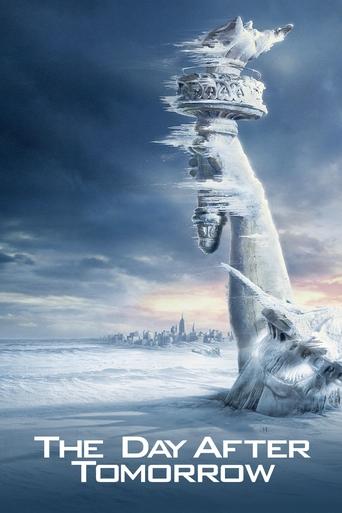
The Day After Tomorrow (2004)
Where will you be?
After paleoclimatologist Jack Hall is largely ignored by UN officials when presenting his environmental concerns about the beginning of a new Ice Age, his research proves true when a superstorm develops, setting off catastrophic natural disasters throughout the world. Trying to get to his son, Sam, who is trapped in New York City with his friend Laura and others, Jack and his crew must travel to get to Sam before it's too late.
- Date of release
- 2004-05-26
- TMDB
- 6.6 / 10 (9301)
- Runtime
- 2h 4m
- Genres
- Science Fiction, Thriller, Adventure
- Director
- Roland Emmerich
Casting
- Dennis Quaid — Jack Hall
- Jake Gyllenhaal — Sam Hall
- Ian Holm — Terry Rapson
- Emmy Rossum — Laura Chapman
- Sela Ward — Dr. Lucy Hall
- Dash Mihok — Jason Evans
- Kenneth Welsh — Vice President Becker
- Jay O. Sanders — Frank Harris
- Austin Nichols — J.D.
- Perry King — President Blake
- Nestor Serrano — Gomez
- Adrian Lester — Simon
Interesting facts
- Box office: $542.8M
- Filmed in: New York City, Toronto, Montreal, and Japan
- Awards: 0 · Nominations: 2
The Day After Tomorrow is a 2004 American science fiction disaster film co-written, co-produced, and directed by Roland Emmerich. Based on the 1999 book The Coming Global Superstorm by Art Bell and Whitley Strieber, the film depicts catastrophic climatic effects following the disruption of the North Atlantic Ocean circulation, in which a series of extreme weather events usher in climate change and lead to a new ice age. The film stars Dennis Quaid, Jake Gyllenhaal, Sela Ward, Emmy Rossum, and Ian Holm.
Production
The Day After Tomorrow was inspired by Coast to Coast AM talk-radio host Art Bell and Whitley Strieber's book, The Coming Global Superstorm, and Strieber wrote the film's novelization. Emmerich wrote a first draft of the script and showed it to producer Mark Gordon, who had produced Emmerich's film The Patriot. Nachmanoff came in to help with rewrites.
The Day After Tomorrow was filmed predominantly in Montreal and Toronto, with some footage also shot in New York City and Chiyoda, Tokyo. Filming ran from November 7, 2002, until October 18, 2003.
The Day After Tomorrow features 416 visual effects shots, with nine effects houses, notably Industrial Light & Magic (ILM), and Digital Domain, and over 1,000 artists, working on the film for over a year.
Although a miniature set was initially considered according to the behind-the-scenes documentary, for the destruction of New York, effects artists instead utilized a 13-block-sized, LIDAR-scanned 3D model of Manhattan, with over 50,000 scanned photographs used for building textures.
Similarly, the opening flyover of Antarctica was also CGI, created by digitally scanning miniature iceberg models created out of sculpted styrofoam; the falling pieces of ice as the shelf cracks were entirely hand-animated. Running for approximately two and a half minutes in length, the scene was at the time the longest continuous all-CGI shot in film history, surpassing the space zoom-out from the opening of Contact (1997).
Read on Wikipedia · Text from Wikipedia, CC BY-SA 4.0. Data from Wikidata.
Recommended
- The Core 2003 · ★ 5.8
- Geostorm 2017 · ★ 6.1
- Armageddon 1998 · ★ 6.8
- Daylight 1996 · ★ 6.2
- War of the Worlds 2005 · ★ 6.6
- The Perfect Storm 2000 · ★ 6.5
- 2012 2009 · ★ 5.9
- When Dinosaurs Ruled the Earth 1970 · ★ 6.2
- Greenland 2: Migration 2026 · ★ 6.4
- Contagion 2011 · ★ 6.7
- The 5th Wave 2016 · ★ 5.9
- The Time Machine 2002 · ★ 6.4