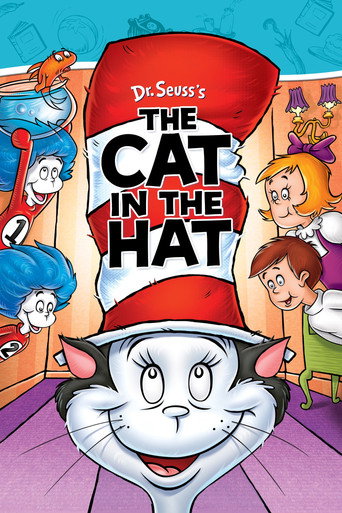
The Cat in the Hat (1971)
After the Cat makes his entrance and fools around a bit, the Fish requests that he leave. He does so, but then comes back in, claiming that his "moss-covered three-handled family grudunza" has been stolen, and he accuses the Fish, who is given the name Karlos K. Krinkelbein in the special. The Cat sings a ballad about the loss of his treasured keepsake and then tries to describe it to the kids, even though they don't understand what he's talking about.
- Erscheinungsdatum
- 1971-03-10
- TMDB
- 6.7 / 10 (58)
- Laufzeit
- 24 Min.
- Genres
- TV-Film, Animation, Familie
- Regie
- Hawley Pratt
Besetzung
- Allan Sherman — The Cat in the Hat (voice)
- Daws Butler — Mr. Krinklebein the Fish (voice)
- Pamelyn Ferdin — Sally (voice)
- Tony Frazier — Boy (voice)
- Gloria Camacho — Mother (voice)
- Thurl Ravenscroft — Thing 1 (voice)
- Gene Morford — Thing 2 (voice) (as Lewis Morford)
Wissenswertes
The Cat in the Hat is an American animated musical television special originally broadcast March 10, 1971 on CBS. It was based on the 1957 Dr. Seuss children's story of the same name, and produced by DePatie–Freleng Enterprises. With voices by Allan Sherman and prolific vocal performer Daws Butler, this half-hour special is a loose adaptation of the book with added musical sequences.
Production
The production began at Chuck Jones' MGM Animation/Visual Arts in the late 1960s after the studio had finished The Phantom Tollbooth and another Dr. Seuss special, Horton Hears a Who!. After MGM stopped animation production and closed down its animation department for good around 1970, along with Seuss being dissatisfied with Jones' style in the previous TV specials, production was moved to DePatie–Freleng Enterprises (marking the company's first…
Although Chuck Jones and his staff were retained by DePatie–Freleng in the production of the special, as a storyboard artist and the producer along with Ted Geisel, Jones left the studio and did not work on any other Seuss projects after The Cat in the Hat. Other staff members that had worked with Jones, such as Dean Elliott and Maurice Noble, eventually stopped working on Seuss projects also.
DePatie–Freleng animated a new Cat in the Hat Productions logo for this special, which would be used in the next three specials. The pace and rhyming sequences of several of the songs (particularly "Calculatus Eliminatus") led many to believe that they were composed by Sherman, since they closely resemble his earlier song parodies; however, only Seuss is credited.
Auf Wikipedia weiterlesen · Text aus Wikipedia, CC BY-SA 4.0. Daten aus Wikidata.
Empfohlen
- Die Trottels 2025 · ★ 5.8
- Coco auf wilder Verfolgungsjagd 2009 · ★ 6.5
- Für Hund und Katz ist auch noch Platz - Die Reise auf dem Hexenbesen 2012 · ★ 6.7
- Der Grüffelo 2009 · ★ 7.4
- Paw Patrol - Die Düsenrettung 2020 · ★ 7.1
- Winnie Puuh - Mein liebster Freund bist Du 1999 · ★ 6.8
- Dog Man: Wau gegen Miau 2025 · ★ 7.3
- Heffalump - Ein neuer Freund für Winnie Puuh 2005 · ★ 6.9
- SpongeBob Schwammkopf: Kamp Grusel 2024 · ★ 7.1
- Es war einmal... nach Roald Dahl 2017 · ★ 6.8
- Disneys Große Pause - All Growed Down 2003 · ★ 6.5
- Willkommen bei den Louds - Der Film 2021 · ★ 7.2