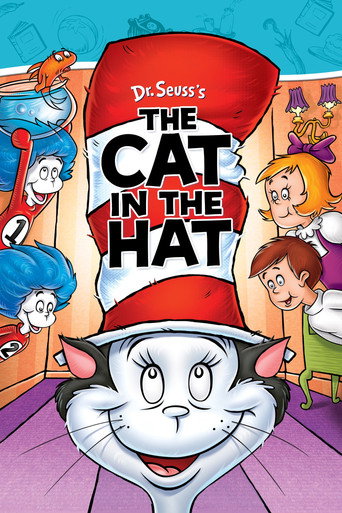
The Cat in the Hat (1971)
Elle est très sérieuse, trop organisée pour être naturelle et ne manque jamais une occasion de blâmer son frère. Il ne pense qu'à s'amuser, ne sait pas ce que " responsabilité " veut dire et n'écoute jamais sa soeur. Alors que leur mère les laisse seuls dans la maison, l'irruption d'un chat géant et de son chapeau magique va leur apprendre à compter l'un sur l'autre et surtout à enfin s'aimer...
- Date de sortie
- 1971-03-10
- TMDB
- 6.7 / 10 (58)
- Durée
- 24 min
- Genres
- Téléfilm, Animation, Familial
- Réalisateur
- Hawley Pratt
Distribution
- Allan Sherman — The Cat in the Hat (voice)
- Daws Butler — Mr. Krinklebein the Fish (voice)
- Pamelyn Ferdin — Sally (voice)
- Tony Frazier — Boy (voice)
- Gloria Camacho — Mother (voice)
- Thurl Ravenscroft — Thing 1 (voice)
- Gene Morford — Thing 2 (voice) (as Lewis Morford)
Anecdotes
The Cat in the Hat is an American animated musical television special originally broadcast March 10, 1971 on CBS. It was based on the 1957 Dr. Seuss children's story of the same name, and produced by DePatie–Freleng Enterprises. With voices by Allan Sherman and prolific vocal performer Daws Butler, this half-hour special is a loose adaptation of the book with added musical sequences.
Production
The production began at Chuck Jones' MGM Animation/Visual Arts in the late 1960s after the studio had finished The Phantom Tollbooth and another Dr. Seuss special, Horton Hears a Who!. After MGM stopped animation production and closed down its animation department for good around 1970, along with Seuss being dissatisfied with Jones' style in the previous TV specials, production was moved to DePatie–Freleng Enterprises (marking the company's first…
Although Chuck Jones and his staff were retained by DePatie–Freleng in the production of the special, as a storyboard artist and the producer along with Ted Geisel, Jones left the studio and did not work on any other Seuss projects after The Cat in the Hat. Other staff members that had worked with Jones, such as Dean Elliott and Maurice Noble, eventually stopped working on Seuss projects also.
DePatie–Freleng animated a new Cat in the Hat Productions logo for this special, which would be used in the next three specials. The pace and rhyming sequences of several of the songs (particularly "Calculatus Eliminatus") led many to believe that they were composed by Sherman, since they closely resemble his earlier song parodies; however, only Seuss is credited.
Lire sur Wikipédia · Texte de Wikipédia, CC BY-SA 4.0. Données de Wikidata.
Recommandés
- Les Deux Gredins 2025 · ★ 5.8
- Georges, Le Petit Curieux 2 - Suivez ce singe 2009 · ★ 6.5
- La sorcière dans les airs 2012 · ★ 6.7
- Le Gruffalo 2009 · ★ 7.4
- La Pat' Patrouille : Mission Voltige 2020 · ★ 7.1
- Winnie l'ourson : Je t'aime toi ! 1999 · ★ 6.8
- Dog Man 2025 · ★ 7.3
- Winnie l'ourson et l'Éfélant 2005 · ★ 6.9
- Kamp Frayeur 2024 · ★ 7.1
- Un Conte peut en cacher un autre 2017 · ★ 6.8
- Mickey et la légende des deux sorcières 2021 · ★ 7.0
- Georges le petit curieux : un incroyable Noël 2009 · ★ 6.7