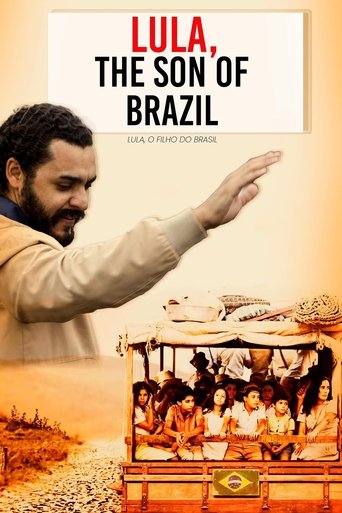
Lula, the Son of Brazil (2010)
Lula, o Filho do Brasil
Family man. Militant. Hero. Convict. Savior. Romantic. Legend.
The true story of a working class boy who moves to the nation's financial capital at a young age and becomes one the most influential politicians in Brazilian history.
- Date of release
- 2010-01-01
- TMDB
- 5.5 / 10 (92)
- Runtime
- 2h 10m
- Genres
- Drama, History
- Director
- Fábio Barreto, Marcelo Santiago
Casting
- Rui Ricardo Diaz — Lula
- Glória Pires — Dona Lindu
- Cleo Pires — Lurdes
- Juliana Baroni — Marisa Letícia
- Milhem Cortaz — Aristides
- Lucélia Santos — Professora
- Antônio Pitanga — Seu Cristóvão
- Celso Frateschi — Seu Álvaro
- Marcos Cesana — Cláudio Feitosa
- Sóstenes Vidal — Ziza
- Antonio Saboia — Vavá
- Clayton Mariano — Lambari
Interesting facts
- Filmed in: São Paulo
- Awards: 0 · Nominations: 1
Lula: Son of Brazil is a 2009 biographical Brazilian film based on the early life of Brazilian president Luiz Inácio Lula da Silva. Directed by Fábio Barreto, the film was released on January 1, 2010. Upon its release, Lula, Son of Brazil was the most expensive Brazilian film ever, with a budget of over 17 million reais, being later surpassed by Nosso Lar. The film was unanimously chosen by a Ministry of Culture commission as Brazil's submission to the 83rd Academy Award for Best Foreign Language Film, despite not having been chosen to compete.
Production
Based on the book of the same name by journalist Denise Paraná, the film narrates the story of Lula from his birth until his mother's death, when he was a 35-year-old union leader detained by the political police of the military dictatorship. The screenplay was written by Paraná, Fábio Barreto and Daniel Tendler. Writer Fernando Bonassi was hired to supervise it.
João Miguel, better known for his role in Cinema, Aspirinas e Urubus, was initially cast as Lula, but declined due to scheduling problems. Tay Lopez was then cast, but declined for medical reasons, since the role required him to gain and lose weight quickly and he suffers from hypertension. Little known 30-year-old stage actor Rui Ricardo Dias was then cast as Lula.
The film was produced by Luiz Carlos Barreto and Paula Barreto, father and sister of the director, respectively. The budget of the film was relatively high for Brazilian cinema standards: over 17 million reais (more than 9.5 million U.S. dollars). The Barretos, who supported Lula in both 2002 and 2006 presidential elections, claimed to have obtained financing without government funds in order to repel criticism from their work.
The shooting of the film began in late January 2009 in the Pernambuco municipality of Garanhuns, Lula's hometown. In February, the second phase of the production began in Santos and Guarujá, cities on the coast of São Paulo where Lula spent most of his childhood. The shooting was predicted to end on March 21, 2009.
Read on Wikipedia · Text from Wikipedia, CC BY-SA 4.0. Data from Wikidata.
Recommended
- All the Way 2016 · ★ 6.7
- São Paulo, Incorporated 1965 · ★ 8.1
- Snow Flower and the Secret Fan 2011 · ★ 6.1
- Coach Carter 2005 · ★ 7.6
- The House on Carroll Street 1988 · ★ 6.0
- Cheaters 2000 · ★ 6.3
- My Dinner with Hervé 2018 · ★ 6.3
- Richard Jewell 2019 · ★ 7.4
- Mary 2024 · ★ 6.3
- Giant 2026 · ★ 6.7
- Kardec 2019 · ★ 6.6
- TalhotBlond 2012 · ★ 6.3