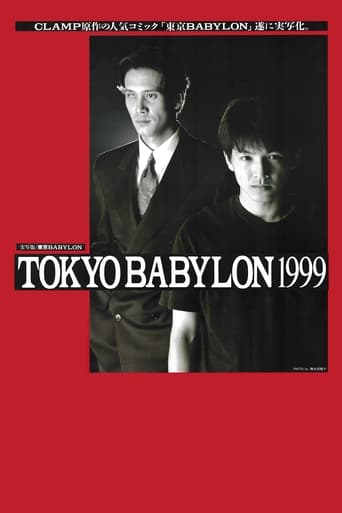
東京BABYLON 1999 (1993)
Subaru is investigating the death of of a enemy, Kaneyama but before he died, he undertook a project, which was how to teach seven teenage girls how to use black magic to get revenge on people they don't like, but when one of the girls feels remorse, she is told by the other girls to continue with the black magic. Subaru tries to stop them but the girls think that he is their enemy and put a curse on him.
- Data lansării
- 1993-08-21
- TMDB
- 6.0 / 10 (4)
- Durată
- 1 h 3 min
- Genuri
- Acțiune, SF, Horror, Thriller, Fantasy
- Regizor
- 飯田譲治
Distribuție
- 東根作寿英 — Subaru Sumeragi
- 四方堂亘 — Seishirô Sakurazuka
- 西尾まり — Megumi
- 佐野和宏 — Kanayama Tomokichi
- 佐藤友紀 — Haruka
- 柚木涼香 — Rie
- Shiho Kitatsuji — Akimi
- Aki Miyase — Kana
- Ritsuko Tsukagoe — Chieko
- Keiko Nagai — Ikue
- Sachiko Miyazaki — Eiko
- Tokuhisa Tanada — Haruka's Father
Curiozități
Tokyo Babylon (東京BABYLON), also known as Tokyo Babylon: A Save Tokyo City Story, is a Japanese manga series written and illustrated by Clamp. It follows Subaru Sumeragi, the head of the Sumeragi clan, and his sister Hokuto, as they work to protect Tokyo from a myriad of supernatural perils while living with a man named Seishiro Sakurazuka. Shinshokan serialized it in their shojo manga magazines South and Wings from 1990 to 1993, and the series was collected into 7 tankōbon volumes.
Production
Tokyo Babylon is based on a one-shot that Clamp head writer Nanase Ohkawa wrote for a magazine that featured dōjinshi. After Clamp got to illustrate the cover of the same magazine, Wings, with Subaru and Hokuto, the magazine proposed Clamp turn it into a series for their special edition South.
Subaru and his twin sister Hokuto, and Seishiro, were conceived by the series' creator Ohkawa for a dōjinshi novel about an onmyōji who hunts elves. Only its beginning remains. The characters were drawn twice for covers, and when South asked Clamp to create a new series for them, these characters were used. Originally, the twins were conceived more as mascots, with Subaru being a penguin called Leone, named after the Subaru Leone car.
When Tokyo Babylon's serialization began, Clamp was also writing RG Veda for the monthly magazine Wings. While the authors found this complicated, the series' quarterly publication of sixty pages resulted in the authors making several changes. The length of each chapter led the authors to write a darker story rather than a soft one as originally planned.
In creating the art, colored weft and light colors were used for the main illustrations. This proved to be difficult for the authors. Ohkawa believes the art was influenced by the years when the manga was published. This is reflected in how Clamp's artwork changed, particularly the clothing and, most notably, Hokuto's dresses. Mokona's works have been drawn with increasingly thicker lines across the serialzation of the manga.
Citește pe Wikipedia · Text din Wikipedia, CC BY-SA 4.0. Date din Wikidata.
Recomandate
- Death Machine 1995 · ★ 5.8
- Răpirea 2019 · ★ 6.1
- Ultimul vampir 2009 · ★ 5.9
- The Unhealer 2021 · ★ 5.8
- Gantz: Perfect Answer 2011 · ★ 6.6
- Cârțile sângelui 2020 · ★ 6.2
- A Knight's War 2025 · ★ 6.2
- Copoi de război 2024 · ★ 6.4
- Death Note: Light Up the New World 2016 · ★ 6.3
- Death Note: L Change the WorLd 2008 · ★ 6.0
- Izolare 2015 · ★ 5.9
- Home Sweet Home: Rebirth 2025 · ★ 5.9