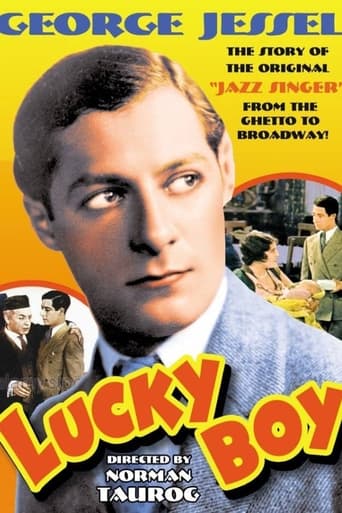
Lucky Boy (1929)
A young Jewish man works in his father's jewelry business, but he doesn't like it at all--he wants to be an entertainer, something he knows that his father would never approve of. He comes up with a scheme to put on his own show in a theater and show his father that he can be a success, but things don't work out quite as well as he planned.
- Erscheinungsdatum
- 1929-02-02
- TMDB
- 5.2 / 10 (4)
- Laufzeit
- 1 Std. 17 Min.
- Genres
- Liebesfilm, Musik
- Regie
- Norman Taurog, Charles C. Wilson
Besetzung
- George Jessel — George Jessel
- Gwen Lee — Mrs. Ellis
- Richard Tucker — Mr. Ellis
- Gayne Whitman — Mr. Trent
- Margaret Quimby — Eleanor
- Rosa Rosanova — Mamma Jessel
- William H. Strauss
- Sig Ruman — Bridge player (Unbilled)
- Glenda Farrell — Secretary at theater (Unbilled)
Wissenswertes
Lucky Boy is a 1929 American sound part-talkie musical comedy-drama film directed by Norman Taurog and Charles C. Wilson, most notable for starring George Jessel in his first known surviving feature picture. In addition to sequences with audible dialogue or talking sequences, the film features a synchronized musical score, singing and sound effects along with English intertitles. The sound was recorded using the Tiffany-Tone system using RCA Photophone equipment. The film's plot bore strong similarities to that of the hit 1927 film The Jazz Singer, which had originally been intended to star Jessel before Al Jolson took over the role.
Production
The film was originally developed with the title The Schlemiel based on a story by Viola Brothers Shore. It was initially filmed without sound by director Norman Taurog under the working title of The Ghetto in April 1928, reportedly in a "record time" of twelve days. Based on his role in the original stage production of The Jazz Singer, Jessel was billed as "The Original Jazz Singer" in advertisements.
Auf Wikipedia weiterlesen · Text aus Wikipedia, CC BY-SA 4.0. Daten aus Wikidata.
Empfohlen
- König der heißen Rhythmen 1964 · ★ 6.0
- Born to Dance 2013 · ★ 5.8
- Brigadoon 1954 · ★ 6.6
- Lachkonzert in Entenhausen 1946 · ★ 5.8
- Salsa 1988 · ★ 6.9
- Osterspaziergang 1948 · ★ 7.1
- George Balanchine's Der Nussknacker 1993 · ★ 5.8
- Sisters of the Groom 2017 · ★ 6.5
- Attraction - Spirale der Gewalt 2001 · ★ 6.9
- Spin – Finde deinen Beat 2021 · ★ 6.9
- Let It Shine - Zeig, was Du kannst! 2012 · ★ 7.0
- Der Jazzkönig 1930 · ★ 6.5