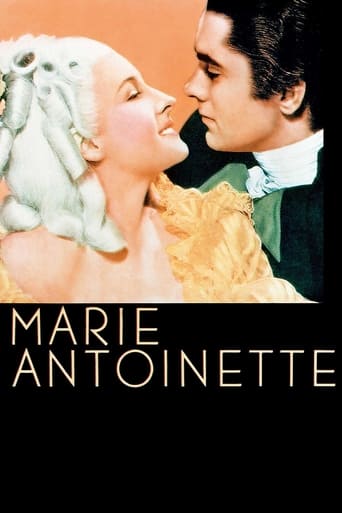
Marie Antoinette (1938)
A Queen... but, first of all... a woman in love!
The young Austrian princess Marie Antoinette is arranged to marry Louis XVI, future king of France, in a politically advantageous marriage for the rival countries. The opulent Marie indulges in various whims and flirtations. When Louis XV passes and Louis XVI ascends the French throne, his queen's extravagant lifestyle earns the hatred of the French people, who despise her Austrian heritage.
- Date of release
- 1938-08-26
- TMDB
- 6.6 / 10 (38)
- Runtime
- 2h 29m
- Genres
- Drama, History
- Director
- W.S. Van Dyke
Casting
- Norma Shearer — Marie Antoinette
- Tyrone Power — Count Axel de Fersen
- John Barrymore — King Louis XV
- Robert Morley — King Louis XVI
- Anita Louise — Princesse de Lamballe
- Joseph Schildkraut — Duke d'Orléans
- Gladys George — Mme. du Barry
- Henry Stephenson — Count de Mercey
- Cora Witherspoon — Countess de Noailles
- Barnett Parker — Prince de Rohan
- Reginald Gardiner — Comte d'Artois
- Henry Daniell — La Motte
Interesting facts
- Based on: Marie Antoinette: The Portrait of an Average Woman
- Awards: 0 · Nominations: 4
Marie Antoinette is a 1938 American historical drama film produced by Metro-Goldwyn-Mayer. It was directed by W. S. Van Dyke and starred Norma Shearer as Marie Antoinette. Based upon the 1932 biography of the ill-fated Queen of France by the Austrian writer Stefan Zweig, it had its Los Angeles premiere at the legendary Carthay Circle Theatre, where the landscaping was specially decorated for the event.
Background
William Randolph Hearst originally planned this film as a vehicle for Marion Davies as early as 1933. However, a clash with Louis B. Mayer after the failure of her film Operator 13 led to the couple switching to neighboring Warner Bros.
Norma Shearer was the wife of MGM studio head Irving Thalberg when this project was greenlit sometime before his death in 1936. This was reportedly Shearer's favorite role.
Originally to be directed by Sidney Franklin, the job was given to W.S. Van Dyke. Irving Thalberg originally planned for Charles Laughton to play the role of Louis XVI, but Laughton, after lengthy deliberations, finally declined.
The film boasted thousands of expensive costumes and lavish set design. The costumes created for the film are among the most expensive in film history. Costume designer Adrian visited France and Austria in 1937 to research the period. While there he purchased vast quantities of antique materials, French lace, and period accessories for use in the film.
The elaborate costumes were subsequently reused multiple times in other period films to offset the cost of their creation. Many have survived and exist in both museum and private costume collections internationally.
Read on Wikipedia · Text from Wikipedia, CC BY-SA 4.0. Data from Wikidata.
Recommended
- Marie Antoinette 2006 · ★ 6.7
- The Count of Monte Cristo 2002 · ★ 7.7
- The Man in the Iron Mask 1998 · ★ 6.7
- Victoria & Abdul 2017 · ★ 6.9
- Colette 2018 · ★ 6.9
- The Current War 2018 · ★ 6.7
- Radium Girls 2020 · ★ 6.6
- Goya's Ghosts 2006 · ★ 6.6
- Munich - The Edge of War 2021 · ★ 6.9
- Viceroy's House 2017 · ★ 6.7
- Hugo 2011 · ★ 7.2
- Les Misérables 2012 · ★ 7.3