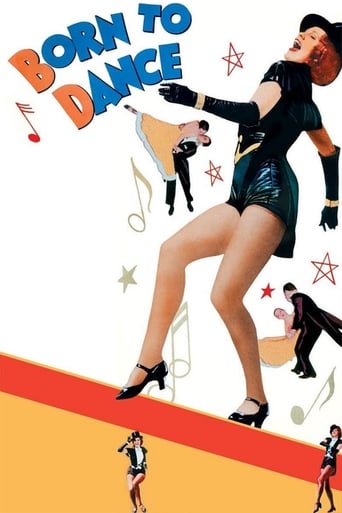
Born to Dance (1936)
M*G*M's successor to 'THE GREAT ZIEGFELD'
On leave, a sailor falls in love with a young lady aspiring to become a Broadway dancer, but their relationship is jeopardized by an established Broadway star, who is also enamored by him.
- Date of release
- 1936-11-27
- TMDB
- 6.1 / 10 (32)
- Runtime
- 1h 45m
- Genres
- Comedy, Music, Romance
- Director
- Roy Del Ruth
Casting
- Eleanor Powell — Nora Paige
- James Stewart — Ted Barker
- Virginia Bruce — Lucy James
- Una Merkel — Jenny Saks
- Sid Silvers — 'Gunny' Sacks
- Frances Langford — 'Peppy' Turner
- Raymond Walburn — Captain Dingby
- Alan Dinehart — McKay
- Buddy Ebsen — 'Mush' Tracy
- Juanita Quigley — Sally Saks
- Georges — Himself
- Jalna — Herself
Interesting facts
Born to Dance is a 1936 American musical film directed by Roy Del Ruth and starring Eleanor Powell, James Stewart and Virginia Bruce. It was produced and distributed by Metro-Goldwyn-Mayer. The score was composed by Cole Porter.
Production
The film's working title was This Time It's Love.
The film stars dancer Eleanor Powell and was a follow-up to her successful debut in Broadway Melody of 1936. The film co-stars James Stewart as Powell's love interest and Virginia Bruce as the film's resident femme fatale and Powell's rival. Powell's Broadway Melody co-stars Buddy Ebsen and Frances Langford return to provide comedy and musical support.
In 1936, a part was written for Judy Garland. Cole Porter wrote in his diary that it was his "great Joy" that he was writing for a film featuring Garland. However, her part was written out of the film before she could begin any work on the film.
The film introduced the Porter standards "You'd Be So Easy to Love" (performed by Stewart and Marjorie Lane, dubbed for Powell) and "I've Got You Under My Skin" (performed by Bruce), which was nominated for the Academy Award for Best Original Song. It was the first film in which Stewart sang.
Some of the musical numbers were recorded in stereophonic sound, making this one of the first films to utilize multi-channel technology. Rhino Records included the stereo tracks in its soundtrack album, released on CD, including Jimmy Stewart's and Marjorie Lane's performance of "You'd Be So Easy to Love."
Read on Wikipedia · Text from Wikipedia, CC BY-SA 4.0. Data from Wikidata.
Recommended
- On the Town 1949 · ★ 7.0
- Blue Hawaii 1961 · ★ 6.0
- You'll Never Get Rich 1941 · ★ 6.5
- The Pirate 1948 · ★ 6.5
- Follow the Fleet 1936 · ★ 6.9
- How to Marry a Millionaire 1953 · ★ 6.8
- Out to Sea 1997 · ★ 5.9
- Yellow Submarine 1968 · ★ 7.2
- Speedway 1968 · ★ 5.9
- Let's Make Love 1960 · ★ 6.4
- G.I. Blues 1960 · ★ 6.5
- Love Happy 1949 · ★ 5.8