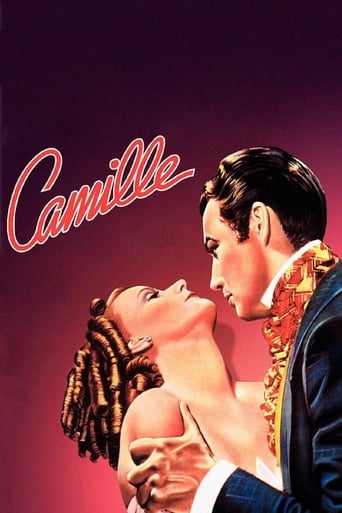
Camille (1936)
You who are so young—where can you have learned all you know about women like me?
Life in 1847 Paris is as spirited as champagne and as unforgiving as the gray morning after. In gambling dens and lavish soirees, men of means exert their wills and women turned courtesans exult in pleasure. One such woman is Marguerite Gautier, who begins a sumptuous romance with Armand Duval.
- Date of release
- 1936-12-26
- TMDB
- 7.0 / 10 (161)
- Runtime
- 1h 49m
- Genres
- Drama, Romance, History
- Director
- George Cukor
Casting
- Greta Garbo — Marguerite Gautier
- Robert Taylor — Armand Duval
- Lionel Barrymore — Monsieur Duval
- Elizabeth Allan — Nichette
- Jessie Ralph — Nanine
- Henry Daniell — Baron de Varville
- Lenore Ulric — Olympe
- Laura Hope Crews — Prudence Duvernoy
- Rex O'Malley — Gaston
- Lita Chevret — Woman in Theatre Box (uncredited)
- E. E. Clive — Saint Gaudens (uncredited)
- Elspeth Dudgeon — Fireplace Attendant (uncredited)
Interesting facts
- Based on: The Lady of the Camellias
- Awards: 2 · Nominations: 1. Including: National Board of Review: Top Ten Films; New York Film Critics Circle Award for Best Actress
Camille is a 1936 American romantic tragedy film from Metro-Goldwyn-Mayer directed by George Cukor, and produced by Irving Thalberg and Bernard H. Hyman, from a screenplay by James Hilton, Zoë Akins, and Frances Marion. The picture is based on the 1848 novel and 1852 play La dame aux camélias by Alexandre Dumas, fils. The film stars Greta Garbo, Robert Taylor, Lionel Barrymore, Elizabeth Allan, Jessie Ralph, Henry Daniell, and Laura Hope Crews. It grossed $2,842,000.
Production
The play had previously been adaptated for film in 1912, 1915 and 1917, in 1921 with Nazimova and Rudolph Valentino, and in 1926 with Norma Talmadge.
Irving Thalberg assigned Davis Lewis to work on the film as associate producer. According to Lewis, Greta Garbo only agreed to make the movie if MGM would finance Conquest.
Francis Marion wrote the first draft of the script with James Hilton; according to Lewis, Marion had a crush on Hilton and the first draft "was ludicrous—flowery, overblown, and just downright badly conceived and overwritten. It was almost comic opera." The director, George Cukor, suggested Zoe Akins be brought in to work on the script.
According to a news item in Daily Variety, MGM had considered changing the setting of the famous Alexandre Dumas story to modern times. The time period was not changed, but Thalberg wanted the film to have a more contemporary feeling than earlier Camilles. He wanted audiences to forget that they were watching a "costume" picture.
While filming Marguerite's death scene, Robert Taylor brought his phonograph to Garbo's dressing room so that she could play Paul Robeson records to put her in the mood.
Read on Wikipedia · Text from Wikipedia, CC BY-SA 4.0. Data from Wikidata.
Recommended
- The Last Time I Saw Paris 1954 · ★ 6.0
- Dangerous Liaisons 1988 · ★ 7.2
- Valmont 1989 · ★ 6.7
- In Secret 2014 · ★ 6.1
- Madame Bovary 1949 · ★ 6.7
- Lady Jane 1986 · ★ 6.9
- Third Person 2014 · ★ 5.9
- Fanny 1961 · ★ 6.7
- The Invisible Woman 2013 · ★ 5.9
- Original Sin 2001 · ★ 6.2
- The French Lieutenant's Woman 1981 · ★ 6.5
- A Woman of Paris: A Drama of Fate 1923 · ★ 6.7