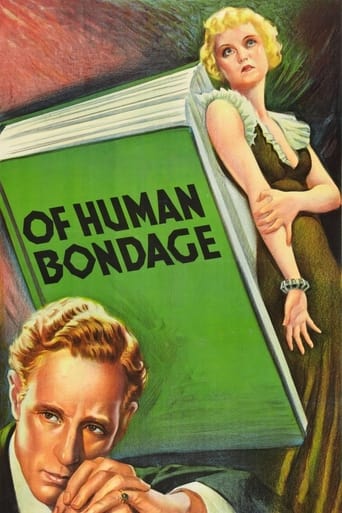
Of Human Bondage (1934)
The Love That Lifted a Man to Paradise......and Hurled Him Back to Earth Again
A young man finds himself attracted to a cold and unfeeling waitress who may ultimately destroy them both.
- Date of release
- 1934-07-20
- TMDB
- 6.5 / 10 (148)
- Runtime
- 1h 23m
- Genres
- Drama, Romance
- Director
- John Cromwell
Casting
- Leslie Howard — Philip Carey
- Bette Davis — Mildred Rogers
- Frances Dee — Sally Athelny
- Kay Johnson — Norah
- Reginald Denny — Harry Griffiths
- Alan Hale — Emil Miller
- Reginald Sheffield — Cyril Dunsford
- Reginald Owen — Thorpe Athelny
- Desmond Roberts — Dr. Jacobs
- Harry Allen — Taxi Driver (uncredited)
- Ray Atchley — J. Murphy (uncredited)
- Frank Baker — Policeman Removing Mildred (uncredited)
Interesting facts
- Based on: Of Human Bondage
- Awards: 0 · Nominations: 1
Of Human Bondage is a 1934 American drama film directed by John Cromwell and regarded by critics as the film that made Bette Davis a star. The screenplay by Lester Cohen is based on the 1915 novel Of Human Bondage by W. Somerset Maugham.
Production
In 1932, director Michael Curtiz showed Cromwell a print of his recently completed film The Cabin in the Cotton because Cromwell was interested in casting its leading man, Richard Barthelmess, in a project he was preparing. Instead of Barthelmess, Cromwell's attention was drawn to Bette Davis, whose portrayal of a femme fatale brought to mind the slatternly waitress Mildred in W. Somerset Maugham's 1915 novel Of Human Bondage.
Screenwriter Wilson Mizner brought a copy of the Maugham novel to Davis, who was in the midst of filming her 20,000 Years in Sing Sing. After reading it and learning RKO held the screen rights, she implored Jack L. Warner to lend her to the rival studio. "At the time, however", Davis later recalled, "Warner Brothers had other plans for me.
In order to prepare for the role, Davis hired an English housekeeper: "She had just the right amount of cockney in her speech for Mildred. I never told her she was teaching me cockney – for fear she would exaggerate her own accent." Her efforts failed to impress Leslie Howard who, along with other British cast members, was upset an American had been cast in the role. "I really couldn't blame them", Davis stated.
Davis designed her own make-up for the scenes depicting the final stages of Mildred's illness, changed from syphilis to tuberculosis to satisfy the demands of the Hays Code, which, under Joseph Breen, was beginning to expand and rigidly enforce an all-encompassing Production Code. On July 1, 1934, three days after the film was released, the upgraded system of censorship was formally announced.
"I made it very clear that Mildred was not going to die of a dread disease looking as if a deb had missed her noon nap. The last stages of consumption, poverty, and neglect are not pretty, and I intended to be convincing-looking. We pulled no punches, and Mildred emerged ... as starkly real as a pestilence."
Read on Wikipedia · Text from Wikipedia, CC BY-SA 4.0. Data from Wikidata.
Recommended
- City Girl 1930 · ★ 7.5
- Kitty Foyle 1940 · ★ 6.6
- The Lost Husband 2020 · ★ 6.6
- Sunrise: A Song of Two Humans 1927 · ★ 7.8
- Prescription for Love 2019 · ★ 6.9
- Bad Girl 1931 · ★ 6.0
- The Whole Wide World 1996 · ★ 6.6
- The Magnificent Ambersons 1942 · ★ 7.3
- Flamingo Road 1949 · ★ 7.0
- My Brilliant Career 1979 · ★ 6.2
- Strangers When We Meet 1960 · ★ 6.4
- In Name Only 1939 · ★ 7.0