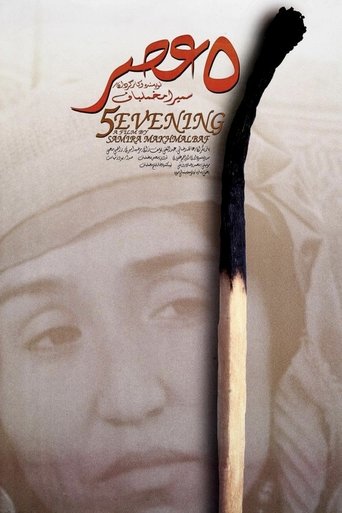
پنج عصر (2003)
Nogreh is a young Afghan woman living with her father and her sister-in-law, Leylomah, whose husband, Akhtar, is missing. Beyond the issue of Akhtar, Leylomah is most concerned with how to feed her baby. She cannot provide milk for her baby as her own hunger is preventing her from lactating. Nogreh, however, aspires toward a life in a western styled democracy. Although the Taliban are no longer in power in Afghanistan, traditional forces are still active in the country. Nogreh often displays signs of rebellion, such as wearing a pair of white pumps instead of the traditional slipper beneath her burqa. But mostly, Nogreh wants to be educated. Without her father's knowledge, Nogreh is attending a secular girls school. Ultimately, she wants to become President of Afghanistan. With the help of a Pakistani refugee who likes her as a woman, Nogreh tries to understand exactly what forces led to current world leaders being elected, those forces which she wants to emulate.
- Data lansării
- 2003-08-20
- TMDB
- 6.6 / 10 (24)
- Durată
- 1 h 45 min
- Genuri
- Dramă
- Regizor
- Samira Makhmalbaf
Distribuție
- Agheleh Rezaie — Noqreh
- Abdolgani Yousefrazi — The father
- Razi Mohebi — The Poet
- Marzieh Amiri — Leylomah
Curiozități
At Five in the Afternoon is a 2003 film by Iranian writer-director Samira Makhmalbaf. It tells the story of an ambitious young woman trying to gain an education in Afghanistan after the 2001 ouster of the Taliban rule. The title comes from a Federico García Lorca poem and is a tale of flourishing against the odds. It was the first film from Afghanistan following the fall of the Taliban.
Development
At Five in the Afternoon was the first film to be shot in Kabul after the NATO invasion. It was an international co-production between the Iranian company Makhmalbaf Productions and the French companies BAC Films and Wild Bunch.
Makhmalbaf had difficulty finding an actress willing to play the lead character. Her original choice for the role would not allow her face to appear on camera.
Samira's 14-year-old sister Hana Makhmalbaf made a documentary about the making of the film, entitled Joy of Madness (Lezate divanegi). It documents Samira's trials and tribulations whilst trying to persuade people in Kabul to take part in her film. As a teenager, Hana was able to amass a lot of digital video footage unnoticed.
Citește pe Wikipedia · Text din Wikipedia, CC BY-SA 4.0. Date din Wikidata.
Recomandate
- Cer 2016 · ★ 6.2
- Blonda bună și înaltă 2012 · ★ 6.3
- Skin 2009 · ★ 6.4
- I Believe in Unicorns 2015 · ★ 6.6
- The Devil's Arithmetic 1999 · ★ 6.8
- Pâinea războiului 2017 · ★ 7.8
- The Girl in the Book 2015 · ★ 5.8
- Call Me Crazy: A Five Film 2013 · ★ 7.0
- The Boy in the Woods 2023 · ★ 7.0
- Normal 2003 · ★ 6.7
- The Ron Clark Story 2006 · ★ 7.6
- Origin 2023 · ★ 6.2