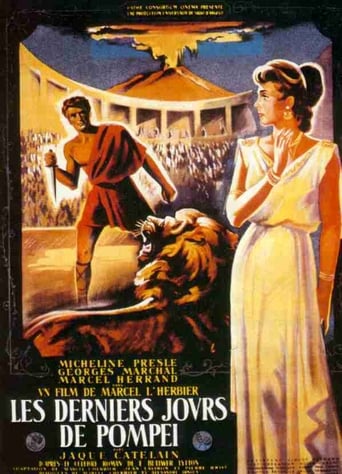
Les Derniers Jours de Pompéi (1950)
In Pompeii in the year 79, Lycias and Helen fall in love. Helen's guardian, the high priest of Isis, wants to separate them. To do so, he tries to make Lycias drink a love potion, but a young slave threatens to reveal everything. The high priest, unable to silence her, kills her and arranges to have Lycias accused...
- 上映日期
- 1950-03-02
- TMDB
- 5.3 / 10 (9)
- 片长(分钟)
- 1小时43分钟
- 类型
- 历史, 剧情
- 导演
- Paolo Moffa, Marcel L'Herbier
演员阵容
- 米歇尔·普雷斯勒 — Hélène
- Georges Marchal — Lysias
- Marcel Herrand — Arbax
- Jaque Catelain — Claudius
- Adriana Benetti — Nidia
- Camillo Pilotto — Diomède
- Antonio Pierfederici — Olinte
- Guglielmo Barnabò — Panza
- Alain Quercy — Lépide
- Laura Alex
- Annibale Betrone
- 克劳迪奥·埃尔梅利
趣闻
The Last Days of Pompeii (1950) is a black and white French-Italian historical drama, directed by Marcel L'Herbier "in collaboration with" Paolo Moffa, who was also the director of production. It was adapted from Edward Bulwer-Lytton's novel The Last Days of Pompeii. The film has also been known as Sins of Pompeii.
Production
Principal filming took place in the summer of 1948 at the Cinecittà studios in Rome. The amphitheatre scenes were filmed at the Arena di Verona. The production was then interrupted however for nearly a year, and was completed at the GTC studios at Joinville/Saint-Maurice in 1949. The film was released in France and Italy in 1950.
The film considerably simplified the plot of Lytton's novel, and there was some alteration of the names of the principal characters: Glaucus became Lysias, and Ione became Hélène; Nidia was made the victim of Arbax rather than an agent of his defeat.
There were set designs and costumes by Aldo Tommasini and Veniero Colasanti, and special effects by B. de Kerblay. Lucio Fulci was 2nd unit director on the film.
Marcel L'Herbier approached the project as one of the "chroniques filmées" ("filmed histories") which his film work had favoured during the previous decade, giving some emphasis to the documentary aspects of the everyday life that had been preserved at Pompeii. He initially approached Albert Camus to write the dialogue (having in mind the latter's play Caligula), but in the event the task was undertaken by Alexandre Arnoux.
在维基百科阅读更多 · 文本来自维基百科,CC BY-SA 4.0。数据来自 Wikidata。