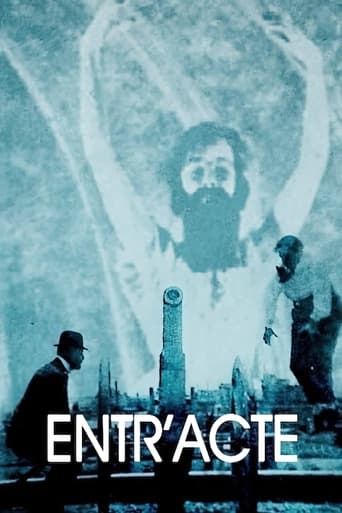
间奏曲 (1924)
Entr'acte
影片的第一个镜头是几个充气的气囊;接着是穿着短裙的芭蕾舞女演员,然后是歌剧院广场的前景和拳击手挥舞剧院的动作。歌剧院广场,一个达达派艺术家在沉思,要烧掉歌剧院。于是,火柴划着了。拳击手挥起双拳再一次向大歌剧院打去。庙宇的立柱。在高楼的平顶上,达达派艺术家曼·雷伊和画家杜尚正在下棋。突然,喷射而来的水搅乱了棋局。女舞蹈演员的舞步。女人的脸和水母的眼。一颗鸟蛋在喷泉吐出的水柱中蹦跳。芭蕾舞团的主要演员扮成罗尔猎人出现在屋顶上。他瞄准鸟蛋。蛋仿佛在水柱中起舞。开枪。蛋壳破裂。一只白鸽破壳而出。达达派画家端着猎枪。瞄准、射击,猎人应声跌落。一辆由骆驼拖曳的灵车载着死者的棺木,缓缓驶在巴黎的郊区大路上。灵柩上放着饼干花环,送葬者挂着哀恸的神情。灵车越走越快,终于狂奔起来。跟在车后的绅士、太太们疯狂追赶。最后,灵车撞到墙上,棺木掀翻,死者穿着魔术师的装束,从棺木里爬出。他挥动魔杖。追来的人群立即消失,他又点了一下自己的胸口,他也倏忽同隐去。
- 上映日期
- 1924-12-04
- TMDB
- 7.0 / 10 (154)
- 片长(分钟)
- 22分钟
- 类型
- 喜剧, 奇幻
- 导演
- René Clair
演员阵容
- Jean Börlin — Hunter / Magician
- Inge Frïss — Bearded ballet dancer
- Marcel Duchamp — Chess player, black set
- Man Ray — Chess player, white set
- Francis Picabia — A man loading the cannon
- Darius Milhaud
- 马塞尔·阿沙尔 — A man following the hearse (uncredited)
- Georges Auric — A man following the hearse (uncredited)
- Georges Charensol — A man following the hearse (uncredited)
- 乔治·拉孔布 — A man following the hearse (uncredited)
- Roger Le Bon — A man following the hearse (uncredited)
- Jean Mamy — A man following the hearse (uncredited)
趣闻
Entr'acte is a silent French Dada short film directed by René Clair. It premiered on 4 December 1924 at the Théâtre des Champs-Élysées in Paris as a prologue and entr'acte for the Ballets Suédois production of Relâche, based on a book by Francis Picabia, which had settings by Picabia, was produced by Rolf de Maré, and was choreographed by Jean Börlin. The music for both the ballet and the film was composed by Erik Satie.
Production and release
For this production, the Dadaists collaborating on the project invented a new mode of production: instantanéisme. The complete film runs for about 20 minutes and uses such techniques as watching people run in slow motion, watching things happen in reverse, looking at a ballet dancer from underneath, watching an egg over a fountain of water get shot and instantly become a bird, and watching people disappear.
The "Prologue" section runs about 90 seconds (though time indications are approximate, as film and music techniques at the time of the premiere did not allow accurate timing). It was played at the beginning of the ballet, right after the "little overture" ("Ouverturette"), and before the curtain was raised ("Rideau"). The music to this part of the film is called "Projectionnette", and is included as the 2nd item in the Relâche partition.
The "Entr'acte" section runs about 18 minutes and 40 seconds. It was played between the two acts of the ballet. The score for this part of the film is not included in the Relâche partition, but was written down by Satie in a separate score, titled "Cinéma".
In 1974, the film was shown at the Cannes Film Festival.
The film was included on the Criterion Collection DVD of Clair's À Nous la Liberté (1931).
在维基百科阅读更多 · 文本来自维基百科,CC BY-SA 4.0。数据来自 Wikidata。