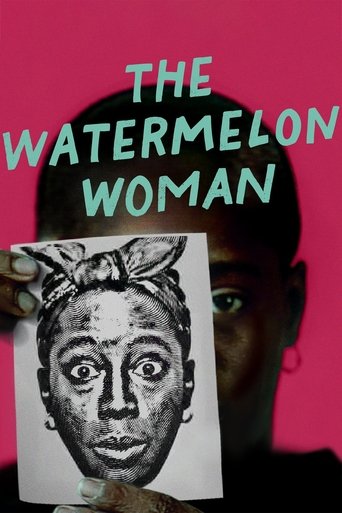
The Watermelon Woman (1997)
Sometimes you have to create your own history.
A young black lesbian filmmaker probes into the life of The Watermelon Woman, a 1930s black actress who played 'mammy' archetypes.
- Date of release
- 1997-03-05
- TMDB
- 7.0 / 10 (133)
- Runtime
- 1h 25m
- Genres
- Drama, Comedy, Romance
- Director
- Cheryl Dunye
Casting
- Cheryl Dunye — Cheryl
- Guinevere Turner — Diana
- Valarie Walker — Tamara
- Lisa Marie Bronson — Fae "The Watermelon Woman" Richards
- Cheryl Clarke — June Walker
- Irene Dunye — Self
- Brian Freeman — Lee Edwards
- Ira Jeffries — Shirley Hamilton
- Alexandra Juhasz — Martha Page
- Camille Paglia — Self
- Sarah Schulman — CLIT Archivist
- V.S. Brodie — Karaoke Singer
Interesting facts
- Awards: 1 · Nominations: 0. Including: Teddy Award
The Watermelon Woman is a 1996 American romantic comedy-drama film written, directed, and edited by Cheryl Dunye. The first feature film directed by a Black lesbian, it stars Dunye as Cheryl, a young Black lesbian working a day job in a video store while trying to make a film about Fae Richards, a Black actress from the 1930s known for playing the stereotypical "mammy" roles to which Black actresses were relegated during the period.
Production
In 1993, Dunye was doing research for a class on Black film history, by looking for information on Black actresses in early films. Many times the credits for these women were left out of the film. Dunye decided that she was going to use her work to create a story for Black women in early films, which became The Watermelon Woman.
The Watermelon Woman was produced on a budget of $300,000, financed by a $31,500 grant from the National Endowment for the Arts (NEA), a fundraiser, and donations from friends of Dunye. The photographic Fae Richards Archive, documenting the fictional actress' life, was created by New York City-based photographer Zoe Leonard. Made up of 78 images, the collection later was exhibited in galleries and as a book.
For the production, Dunye conducted her research at the Lesbian Herstory Archives and the Library of Congress. However, she quickly discovered that neither had the specific resources she was looking for and accessing them was beyond her budget, causing her to stage 78 of the archival photographs featured.
In the film, the protagonist Cheryl, played by the director, is an aspiring Black lesbian filmmaker attempting to bring about the history of Black lesbians in cinematic history while attempting to produce her own work, saying "our stories have never been told." The mockumentary explores the difficulty in navigating archival sources that either excludes or ignores Black lesbians working in Hollywood, particularly that of actress Fae Richards whose…
Dunye has said she found inspiration from the films Swoon (1992) and Norman... Is That You? (1976).
Read on Wikipedia · Text from Wikipedia, CC BY-SA 4.0. Data from Wikidata.
Recommended
- A Perfect Ending 2012 · ★ 6.2
- Shortcomings 2023 · ★ 6.0
- Step Up 2006 · ★ 6.9
- Happiest Season 2020 · ★ 7.1
- The Incredibly True Adventure of Two Girls in Love 1995 · ★ 6.3
- Husbands and Wives 1992 · ★ 7.0
- Posthumous 2014 · ★ 5.9
- Chasing Papi 2003 · ★ 6.7
- The Philadelphia Story 1940 · ★ 7.5
- New York, I Love You 2008 · ★ 6.0
- Loving Annabelle 2007 · ★ 6.6
- Are You There God? It's Me, Margaret. 2023 · ★ 7.1