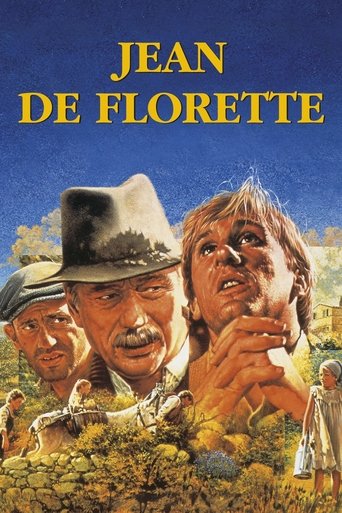
Jean de Florette (1986)
For some men, land and water are more precious than flesh and blood.
In a rural French village, an old man and his only remaining relative cast their covetous eyes on an adjoining vacant property. They need its spring water for growing their flowers, and are dismayed to hear that the man who has inherited it is moving in. They block up the spring and watch as their new neighbour tries to keep his crops watered from wells far afield through the hot summer. Though they see his desperate efforts are breaking his health and his wife and daughter's hearts, they think only of getting the water.
- Date of release
- 1986-08-27
- TMDB
- 7.7 / 10 (642)
- Runtime
- 2h 2m
- Genres
- Drama
- Director
- Claude Berri
- Collection
- The Water of the Hills Collection
Casting
- Yves Montand — César Soubeyran, dit "Papé"
- Gérard Depardieu — Jean Cadoret
- Daniel Auteuil — Ugolin Soubeyran, dit "Galinette"
- Elisabeth Depardieu — Aimée Cadoret, épouse de Jean
- Margarita Lozano — Baptistine, habitante de la grotte
- Ernestine Mazurowna — Manon Cadoret, fille de Jean et Aimée
- Armand Meffre — Philoxène, maire du village
- André Dupon — Pamphile
- Pierre Nougaro — Casimir
- Jean Maurel — Anglade
- Roger Souza — Ange
- Didier Pain — Eliacin
Interesting facts
- Based on: Jean de Florette
- Filmed in: Riboux, Mirabeau, Ansouis, Sommières, and Chapelle Saint-Joseph de Vaugines
Jean de Florette is a 1986 French period drama film directed by Claude Berri. It is the first part of a diptych with Manon of the Spring, released the same year. Both are the adaptation of Marcel Pagnol’s 1962 two-part novel The Water of the Hills, with the second part also being adapted from Pagnol's original 1952 film Manon of The Spring. Berri's version was the first attempt at adapting the whole saga, including the first part, Jean de Florette, which was originally written as a prequel to the novelization of Manon of The Spring.
Production
While the film is adapted from a novel by Marcel Pagnol, the novel was itself adapted from a film directed in 1952 by Pagnol, Manon des Sources. That two-part film told the story of Jean's daughter Manon while Jean, already dead, only appeared in brief flashbacks. The complete film was four hours long, and subsequently cut by its distributor. Pagnol was dissatisfied with the cuts and also felt the need to expand the story.
Berri contacted Jacqueline Pagnol, Marcel Pagnol's widow, who managed her husband's legacy and had also starred as Manon in the 1952 film. She proved reluctant to sell the adaptation rights and asked Berri to first present her with a viable project. It took Berri several years to secure her approval; in 1983, after completing his film So Long, Stooge, he contacted Pagnol again and managed to convince her.
So Long, Stooge had starred comedian Coluche in his first dramatic role. Berri initially sought to continue his successful association with Coluche by casting him as Ugolin. However, Coluche, who was from the Paris area, was uncomfortable with the idea of doing a fake Provençal accent. Also, his first screen tests proved unconvincing. Coluche ended up demanding a salary of 11 million francs in order to ensure that Berri would not hire him.
After Coluche left the project, Berri considered casting Jacques Villeret as Ugolin but Montand vetoed that choice. Also, Pagnol's family requested that the character be played by an actor who really came from the South. The role eventually went to Daniel Auteuil, who had grown up in Avignon and, while he did not speak with a Southern accent, felt comfortable reproducing it.
For Yves Montand the filming experience was particularly trying because his wife of thirty-three years, Simone Signoret, died during filming. Montand himself died in 1991, and the two films were among the last of a cinematic career spanning forty-five years. Having grown up in nearby Marseille, he visited the location before filming started, and endeared himself to the locals.
Read on Wikipedia · Text from Wikipedia, CC BY-SA 4.0. Data from Wikidata.
Recommended
- Army of Shadows 1969 · ★ 7.9
- Bloody Milk 2017 · ★ 6.9
- On Guard 1997 · ★ 6.7
- In the Beginning 2009 · ★ 6.6
- The House by the Sea 2017 · ★ 6.5
- Fanny 2013 · ★ 6.7
- The Dazzled 2019 · ★ 6.9
- La Belle Équipe 1936 · ★ 7.4
- My Father's Glory 1990 · ★ 7.3
- The Minister 2011 · ★ 6.4
- Stillwater 2021 · ★ 6.6
- The Horse 1970 · ★ 6.9