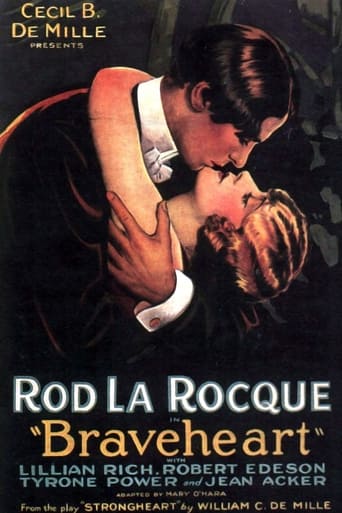
Braveheart (1925)
THE son of an indian Chief, he loved a white girl- He makes a noble sacrifice, then-Can white and red blood mix?
Chief Standing Rock's tribe has a treaty protecting their fishing grounds, but a canning corporation is violating the treaty through intimidation and force. The tribe is divided as to how to handle the threat. Standing Rock's son, Braveheart, is sent to college to study law so that he can protect their rights, but others in the tribe, led by the hot-tempered Ki-Yote, want to provoke a more violent confrontation.
Casting
- Rod La Rocque — Braveheart
- Lillian Rich — Dorothy Nelson
- Robert Edeson — Hobart Nelson
- Arthur Housman — Frank Nelson
- Frank Hagney — Ki-Yote
- Jean Acker — Sky-Arrow
- Tyrone Power Sr. — Standing Rock
- Sally Rand — Sally Vernon
- Henry Victor — Sam Harris
Interesting facts
Braveheart is a 1925 American silent contemporary Western film directed by Alan Hale Sr. and starring Rod La Rocque. The story focuses on members of a tribe of Indians who are being intimidated by the owners of a canning company seeking to violate a treaty protecting the tribe's fishing grounds. Braveheart is a remake of the 1914 film Strongheart directed by James Kirkwood Sr. and produced by the American Mutoscope and Biograph Company. The two films are based on Strongheart, the first play of the producer Cecil B. DeMille's brother William C. deMille.
Production
Braveheart was directed by Alan Hale Sr. and produced by Cecil B. DeMille's production company DeMille Pictures Corporation. The movie was initially named "Strongheart" after a play written by Cecil's brother William C. deMille and produced on Broadway in 1905. Stage actor Robert Edeson had portrayed the leading role in deMille's Broadway play. However, as the success of the play continued, a remake of the 1914 film was undertaken. Nipo T.
The leading character of the movie was not dressed up in Indian costumes because it was a contemporary story (which was also in the original play). The lead role was performed by Rod La Rocque.
One scholar said had said that: The court sequence is heavily and multiply textualized… conveying legal arguments and judgments that refer to treaties.… the judge's decision parses the meaning of the treaty text itself: "We have examined the Federal treaty with the Indians and find that it gives them the right to fish where and when they please, without limitation by State tax or private ownership."
Read on Wikipedia · Text from Wikipedia, CC BY-SA 4.0. Data from Wikidata.
Recommended
- Ramrod 1947 · ★ 6.5
- Go West 1940 · ★ 6.6
- Man Without a Star 1955 · ★ 6.4
- The Five 2023 · ★ 5.9
- The Stalking Moon 1968 · ★ 5.9
- Gunless 2010 · ★ 6.4
- Hud 1963 · ★ 7.3
- True Grit 1969 · ★ 7.3
- The Westerner 1940 · ★ 7.1
- Shane 1953 · ★ 7.3
- The Last Hunt 1956 · ★ 6.9
- The Bravados 1958 · ★ 6.6