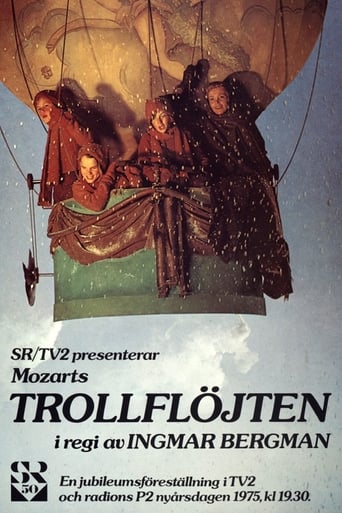
Trollflöjten (1975)
Regina Noptii isi ofera singura fiica, pe Pamina, lui Tamino, dar acesta are datoria de a o aduce inapoi de la tatal ei, preotul Sarastro...
- Data lansării
- 1975-10-04
- TMDB
- 7.2 / 10 (104)
- Durată
- 2 h 15 min
- Genuri
- Muzică, Romantic, Fantasy
- Regizor
- Ingmar Bergman
Distribuție
- Josef Köstlinger — Tamino
- Irma Urrila — Pamina
- Håkan Hagegård — Papageno
- Elisabeth Erikson — Papagena
- Britt-Marie Aruhn — Första damen (First Lady)
- Kirsten Vaupel — Andra damen (Second Lady)
- Birgitta Smiding — Tredje damen (Third Lady)
- Ulrik Cold — Sarastro
- Birgit Nordin — Nattens Drottning (Queen of the Night)
- Ragnar Ulfung — Monostatos
- Erik Sædén — Talaren
- Ulf Johansson — Andra prästen (Second Priest)
Curiozități
- Bazat pe: Flautul fermecat
- Premii: 0 · Nominalizări: 2
The Magic Flute is Ingmar Bergman's 1975 film version of Wolfgang Amadeus Mozart's opera Die Zauberflöte. It was intended as a television production and was first shown on Swedish television on 1 January 1975, but was followed by a theatrical release later that year. The work is widely viewed as one of the most successful films of an opera ever made, and as an unusual item among the director's works.
Production
In producing the opera, Bergman sought to fulfill his early dream of a production in the Drottningholm Palace Theatre (one of the few surviving Baroque theatres in the world). This setting would approximate the conditions of the original 1791 production in the Theater auf der Wieden in Vienna. The introductory exterior shots of the film are intended to suggest that it was indeed filmed in the Drottningholm theatre.
Bergman asked his friend Hans Schmidt-Isserstedt to conduct the opera, but he flatly refused. Choir conductor Eric Ericson also declined at first but was later persuaded by Bergman to take it on.
The costumes were the work of Henny Noremark and Karin Erskine; the two received an Academy Award nomination for their work.
The film is notable as the first made-for-television film (and filmed in then-standard 4:3 television aspect ratio) with a stereo soundtrack. It was shot in 16 mm. film as an economy measure, but released in the standard theatrical 35 mm format. The cinematographer was Bergman's longtime colleague Sven Nykvist.
The process of creating the film began with a recording session, starting 6 April 1974, at the Circus Theater in Stockholm. In addition to the singers who appeared in the film, the musical forces included the Swedish Radio Symphony Orchestra and Ericsson's own choir, the Swedish Radio Choir. This recording provided a carefully sung version with balanced audio, to which the singers later synchronized their mimed singing during filming.
Citește pe Wikipedia · Text din Wikipedia, CC BY-SA 4.0. Date din Wikidata.
Recomandate
- Apasă Redă 2022 · ★ 6.4
- Frumoasa și Bestia: A 30-a aniversare 2022 · ★ 6.8
- Prince Charming 2001 · ★ 6.9
- Magie ciudată 2015 · ★ 7.3
- Tom Degețelul 1958 · ★ 6.4
- The Thief of Bagdad 1924 · ★ 7.3
- Alice's Adventures in Wonderland 1972 · ★ 6.2
- The Nutcracker 1993 · ★ 5.8
- Zombi 2 2020 · ★ 7.4
- Deasupra umbrelor 2019 · ★ 6.7
- Zi după zi 2018 · ★ 7.2
- Gay Purr-ee 1962 · ★ 6.6