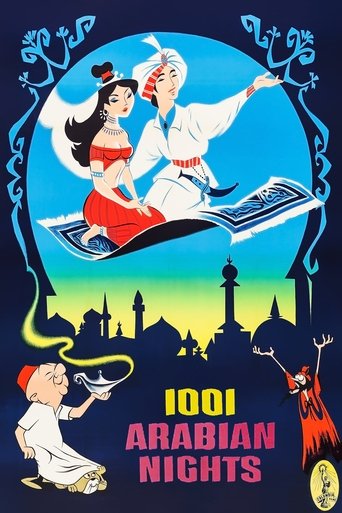
1001 Arabian Nights (1959)
1001 wonderful sounds and sights
In this animated retelling of the classic tale, Abdul Aziz Magoo -- an ancestor of Mr. Magoo -- is the lamp-selling uncle of Aladdin. Tired of his nephew's laziness, Abdul insists that Aladdin find a wife. To his uncle's surprise, Aladdin falls in love with the beautiful Princess Yasminda. Before he can make his move, however, Aladdin is whisked away by the evil Wazir on a quest to find a magic lamp that will grant its owner unlimited power in the form of three magic wishes.
- Date of release
- 1959-12-01
- TMDB
- 6.6 / 10 (15)
- Runtime
- 1h 15m
- Genres
- Animation, Fantasy, Comedy, Family
- Director
- Jack Kinney
Casting
- Jim Backus — Uncle Abdul Azziz Magoo (voice)
- Kathryn Grant — Princess Yasminda (voice)
- Dwayne Hickman — Aladdin (voice)
- Hans Conried — The Wicked Wazir (voice)
- Herschel Bernardi — The Jinni of the Lamp (voice)
- Alan Reed — The Sultan (voice)
- Daws Butler — Omar the Rugmaker / The Royal Accountant / Heralds (voice)
- The Clark Sisters — The Three Little Maids from Damascus (voice)
Interesting facts
1001 Arabian Nights is a 1959 American animated comedy film produced by United Productions of America (UPA) and distributed by Columbia Pictures. Released to theaters on December 1, 1959, the film is a loose adaptation of the Arab folktale of "Aladdin" from One Thousand and One Nights, albeit with the addition of UPA's star cartoon character, Mr. Magoo, to the story as Aladdin's uncle, "Abdul Azziz Magoo". It is the first animated feature to be released by Columbia Pictures.
Production
The film was originally directed by Pete Burness, who was the series director on the popular series of Mr. Magoo theatrical cartoons produced for Columbia by UPA between 1949 and 1959. Disagreements with producer and UPA owner Stephen Bosustow led to Burness resigning and Bosustow recruiting Jack Kinney, the director of many of Disney's Goofy cartoons, as the film's new director.
1001 Arabian Nights was the first full-length feature produced by UPA, a studio which had revolutionized animation during the 1950s by incorporating design and limited animation. The film was not a box-office success, and was UPA's final release through Columbia, which had ended its distribution for the UPA short subjects in favor of lower-cost Loopy De Loop cartoons from Hanna-Barbera Productions.
Read on Wikipedia · Text from Wikipedia, CC BY-SA 4.0. Data from Wikidata.
Recommended
- The Monkey King 2023 · ★ 6.5
- Revolting Rhymes 2017 · ★ 6.9
- Minions & More Volume 1 2022 · ★ 7.0
- Pooh's Heffalump Movie 2005 · ★ 6.9
- The Loud House Movie 2021 · ★ 7.2
- Tweety's High Flying Adventure 2000 · ★ 6.6
- Welcome to Smelliville 2021 · ★ 6.7
- Animal Crackers 2018 · ★ 6.4
- The Brave Little Toaster to the Rescue 1997 · ★ 6.1
- DuckTales: The Movie - Treasure of the Lost Lamp 1990 · ★ 6.7
- The Twits 2025 · ★ 5.8
- Bon Voyage, Charlie Brown (and Don't Come Back!) 1980 · ★ 6.4